

Danny’s Thoughts, Reviews, and Musings

Theological Rationale for Church Technology
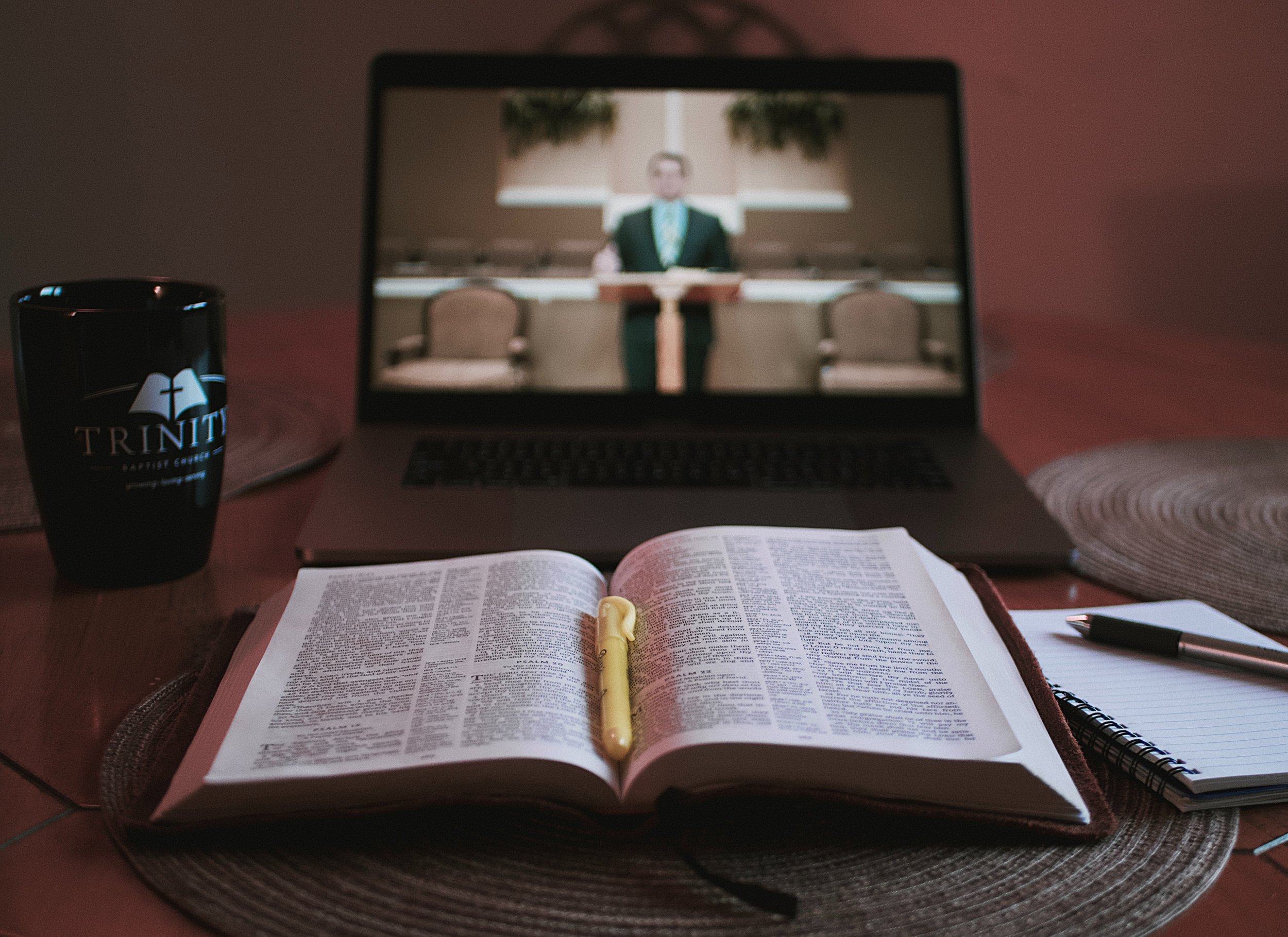
Technology uses scientific knowledge to solve practical problems, especially in industry and commerce. Information technology takes scientific knowledge and applies it specifically to transmitting information from one person to another. In our world, this application takes the form of computers, the internet, streaming services, and more. In the Old and New Testaments world, information technology was lower Tech.
Defining Tech in Scripture
While Scripture is not a scientific book, Scripture describes technological advancements multiple times. Two types of advancements explored are physical tech and information tech. Physical tech refers to the advancements found as tools develop. Information tech refers to the way information transfers between two individuals.
Physical Tech
The growth of physical Tech takes place throughout the Bible. In the initial Genesis passages, God explains to Adam the consequences of his sin would require more challenging work. By the time the story reaches Cain and Abel, Adam and Eve's children, technology has advanced enough to allow Cain to work the field and Abel to shepherd animals. Hard to believe the shepherd's crook was ever considered high Tech.
Towards the end of I Samuel 13, a story about Jonathan and Saul fighting the Philistines details where technology stood at that moment in history:
19 Now there was no blacksmith to be found throughout all the land of Israel, for the Philistines said, "Lest the Hebrews make themselves swords or spears." 20 But every one of the Israelites went down to the Philistines to sharpen his plowshare, his mattock, his axe, or his sickle, 21 and the charge was two-thirds of a shekel for the plowshares and for the mattocks, and a third of a shekel for sharpening the axes and for setting the goads. 22 So on the day of the battle, there was neither sword nor spear found in the hand of any of the people with Saul and Jonathan, but Saul and Jonathan, his son, had them. 23 And the garrison of the Philistines went out to the pass of Michmash.
The Philistines had intentionally withheld physical technology from the Israelites in the promised land. Their concerns revolved around the possibility the Israelites would take technological advancement and make instruments with which they could wage war. God controlled the reality of the situation, and in subsequent chapters, lesser technology defeats more fantastic technology. David comes forward with his simple stone tech and destroys the Giant's advanced technology. David takes the Giant's advanced technology and uses it to decapitate the Giant.
Physical technology makes appearance after appearance throughout the Bible. Owners of nets were not afraid to cast them out and pull in groups of fish. Did they still go with simple poles and try to catch one fish at a time? Owners of boats were excited when sails could catch the wind, and they no longer had to row across the Sea of Galilee. They were probably less excited when the wind died and had to break out the oars, a lesser technology.
Information Tech
The first example of Information Tech occurs in Genesis 1. God speaks, and the universe exists and obeys. However, we see the first example of information technology between humanity and Deity in the Garden of Eden. In Genesis 2, a story explains the first time two beings worked together to accomplish something extraordinary. God and Adam work together to name all the animals. "The man gave names to all livestock and to the birds of the heavens and to every beast of the field. But for Adam, there was not found a helper fit for him (Genesis 2:20 ESV)."
Don't close your eyes. Reading this paragraph is necessary to imagine. God communicates to Adam the plan for the day. "I have created all these other living things. Today, I will let you into the creative process, and you get to name them." God tells Adam. The creative portion of God speaking things into existence sparks Adam's imagination, and now his words will carry some weight as he names each animal.
Information moves from the infinite to the finite. A human communicates with the Deity, and an understanding strikes between them. God causes an animal to parade in front of Adam. The animal is unfriendly. It walks on four legs. While it seems to walk loving toward Adam, in an instance, claws come out, and Adam decides the erratic nature of this animal deserves a name that will forever classify it as an enemy of humanity. "It's a cat," Adam says. Adam asks God, "Can you show me its opposite?" Adam runs this four-legged animal. It bowls him over and starts to lick all over Adam's face. The animal keeps pushing Adam until he pets it. The animal jumps up and runs and grabs a stick. Returning to Adam, the four-legged beast pushes the stick into Adam's hand. Adam throws it, and the animal bolts after it like an arrow. Adam thinks to himself," I could love this thing." New information spawns, and the dog's name is synonymous with man's best friend.
Oral tradition gives way to paper and pen. Paper and pen give way to the printing press. The printing press gives way to the internet. The internet gives way to apps. Information technology keeps moving forwards even as one disciple laments the need to use it. John Dyer points out John's lack of excitement about being forced to use pen and paper (Dyer, John. From the Garden to the City: The Redeeming and Corrupting Power of Technology. Grand Rapids, Mi: Kregel Publishing, 2010. pg. 30 - Discerning technology.). The Apostle John says in 2 John 1:12:
"Though I have much to write to you, I would rather not use paper and ink. Instead, I hope to come to you and talk face to face so that our joy may be complete."
What do these usages of technology lead us to conclude?
Updates to technology have occurred throughout history. Crooks become swords, spears, lyres, and harps. Those transform into books, paper, pens, and rock guitars. Are these items good or bad? Do they lead people toward Christ or away from him? John Dyer posits an exciting thought: Tech is never neutral (Dyer, John. From the Garden to the City: The Redeeming and Corrupting Power of Technology. Grand Rapids, Mi: Kregel Publishing, 2010. pg. 15). I believe technology has three different ends: good, bad, and unexpected.
The improper use of technology comes in lots of forms. Technology in the hands of the Philistines kept the Israelites oppressed. Withholding technology, the Philistines were able to keep the Israelites from rising at them. They even began using technology negatively against the Israelites. The battles they fought included armor and weapons the Israelites would not have access to utilize the Tech against them. From our viewpoint and assessment, the Philistines were using technology to harm and not help. We must look at our technology and assess its harmful usage as a church. We have a biblical responsibility to add appropriate filters to block porn, steward every tech dollar, and implement a technology policy that will glorify God and build the kingdom.
The Scripture says only Jonathan and Saul had swords. Israel was technology deficient. No one in Israel could upgrade or gather resources to fight. Yet, we see them utilize their technology to do what they need. "Now there was no blacksmith to be found throughout all the land of Israel… But every one of the Israelites went down to the Philistines to sharpen his plowshare, his mattock, his axe, or his sickle 91 Samuel 13:19-20 ESV)." When we view this through the perspective of God's plan, we view this Scripture and see the Israelites needed the right technology for the job. They needed updates and upgrades. Walter Wilson, in his book, The Internet Church, explained it this way for the Church:
"The dramatic and startling changes seen through the lens of technology indicate that God is doing something tremendous at this moment in history. These developments are changing society, economics, and politics at an increasingly rapid pace. It is important for the position of the Church and the delivery of God's message in the twenty-first century that we understand the direction and speed of these changes (Wilson, Walter P. The Internet Church: The Local Church Can’t Be Just Local Any More. Nashville: Word Publishing, 2000. pg 43)."
As a church, we should have the same response as the Israelites. We need to accept new technologies and embrace the opportunities as ways to reach more people for Christ. We need to have the right equipment, perform the necessary updates and update the policies as we move forward in building the kingdom. Performing these tasks will allow God's people to do God's work efficiently and effectively and keep guardrails that protect our hearts and minds.
Often the usage of technology follows the law of unintended consequences. What serves at first often devolves into unexpected things. The Philistines knew this could happen to them. They wanted to hoard the technology to keep the Israelites from destroying them. What started as a noble cause turned into the oppression of other people. The initial purpose tracked well, but the Israelites' oppression caused an unintended consequence that their technology did not support. As churches, we see these unintended consequences all the time. For example, we use projectors to put the Scriptures on the screens. This act allows everyone attending our service to read the Bible and not feel left out. However, when there is no incentive to bring your Bible to Church. We have watched this play out here at Cross Mountain. Others have seen it as well. John Dyer served as a youth pastor and saw this same phenomenon happen at his youth group. As he points out, "I never considered that the projector would completely transform the way my students encountered God's Word (Dyer, John. From the Garden to the City: The Redeeming and Corrupting Power of Technology. Grand Rapids, Mi: Kregel Publishing, 2010. pg. 23)."
All three of these responses to technology deserve our attention and our understanding. However, technology is not neutral and requires time as we think through solutions we want to implement, develop the implementation process, and implement it. Who we are and what we believe requires us to look deeper.
Book of the Month - April
a scandalous beauty
Thomas Schmidt - ISBN: 9781587430176 - 2002
Author:
Thomas Schmidt has served as a professor at both religious and secular institutions. When the book was published he was the director of the Westminister Institute. According to Wipfandstock.com, he received his Ph.D. from Cambridge. He also currently lives in Vermont where he also teaches.
Brief Synopsis:
The book, a scandalous beauty, reads a little differently from most books. Thomas Schmidt wrote each chapter as a standalone easy. This fact means you can jump into the book at any point. From the first chapter on the Christian 4 letter word to the chapter on death and power, each essay holds truth and not one chapter disappoints the reader. Schmidt uses imagination mixed with a little bit of sarcasm for the chapter where Jesus goes to therapy. Schmidt’s vivid prose and historical knowledge combine to address Mark’s recounting of the crucifixion in comparison to the Roman procession for the Emperor. He finishes the book with an exploration of eternity and “God’s restoration of order from human chaos and rebellion.”
Insights:
“What Luck. To end up on death row the very day that the person in the cell next to you happens to be the Savior of the world. Don’t you think the thief on the cross was the one thief in the world who would benefit from being at that place at that moment?” - pg. 15
“Psychiatrist: When did you begin to sense confusion and hostility from people, and how did that make you feel?
Jesus: It wasn’t the common people who objected; it was the religious leaders. They wanted to please God by making and following perfect rules. AS soon as I began to teach and to heal, they believed that I was breaking their rules and offending God.” - pg. 54
“God save us from communion bread disguised by silver platters and lace doilies. We eat raw chunks of him together, or we die alone. The words of Jesus (eat my flesh and drink my blood) and the thoughts behind them are too grisly and too deep and too unsafe for a disciple to invent. Jesus clearly thought that people could only thrive in this life if they joined together continually for this relentless absorption of him, piece by piece.” - pg. 98
Should I read it or skip it?
Dr. Ken Huggins taught me most of what I know about the New Testament. He taught Survey of the New Testament at the Logsdon Seminary extension campus I attended. On a whim, he recommended this book to our class. Ever since he told us about it, this book landed and stays on my every Easter Read list. I love the essay format which means I don’t have to read every chapter every year. The scholarship and the broadness of the topics make this book one I hand out copies to people I love as Easter gifts. This book is definitely a must-read.

Book of the Month - March
Open and UnAfraid: The Psalms as a Guide to Life
W. David O. Taylor - ISBN: 978-1-4002-1047-3 - 2020
Author:
David Taylor is a theologian, author, speaker, priest, and director of initiatives in art and faith. A professor at Fuller Theological Seminary, he has lectured widely on the arts, from Thailand to South Africa. He has written for The Washington Post, Image Journal, Theology Today, Worship, Religion News Service, Christianity Today, and Books & Culture, among others. He lives in Austin with his wife Phaedra, a visual artist and gardener, and his daughter Blythe and son Sebastian. - taken from https://www.wdavidotaylor.com/about
Brief Synopsis:
Open and UnAfraid brings the reader to a place of understanding of the Psalms. The book works to help the reader look at Psalms through different lenses. Taylor looks for themes among the Psalms and permits us to see them in a different light. The chapter names give you insight into how the book is structured, names as honesty, communication, death, justice, or creation. This book attempts to answer the question, “ How can we find a more transparent, resilient, and fearless life of faith? Look to the Psalms.” The books of the law given by Moses came to humans as five books. For centuries, man’s answer was the five books of the Psalms. The Psalms provide insight into how to talk with God and live in an open relationship with him. Taylor takes us on that journey.
Insights:
“What the psalms offer us is a powerful aid to un-hide: to stand honestly before God without fear, to face one another vulnerably without shame, and to encounter life in the world without any of the secrets that would demean and distort our humanity” - page 2
“One of the most striking things about these lament psalms is that they include the interrogation of God. This, as it turns out, is a divinely approved form of address. Psalm 121:4 confesses that the Lord is the one who neither sleeps nor slumbers but watches over us. But in Psalm 44:23, the psalmist dares to say, “Awake, Lord! Why do you sleep? Rouse yourself! Do not reject us forever” (NIV). Here, the psalmist sounds like Elijah, who taunts the priests of the god Baal: Shout louder! . . . Surely he is a god! Perhaps he is deep in thought, or busy, or traveling. Maybe he is sleeping and must be awakened. (1 Kings 18:27 NIV) Is this the way one speaks to the Maker of heaven and earth? Is this how you talk to the Holy One? Is this how we ought to address the Sovereign God? According to the psalmist, the answer is, at times, yes.” - page 72
“The psalmists see structural injustice within society, where Christians, perhaps especially evangelicals in the West, may see only personal guilt. The psalmists see the wickedness that pervades institutions and cultures, while Christians may see only the need for the forgiveness of individual sins.
The psalmists see powerless people who are oppressed by the powerful, and so they pray for justice (Pss. 37; 82; 11); Christians see only Psalm 51 with its plea for mercy. Writes C. S. Lewis, "Christians cry to God for mercy instead of justice; they [the psalmists] cried to God for justice instead of injustice."
It isn't that mercy and justice are opposed in the Psalter; they belong together intimately and integrally. But while many Christians give justice half the attention they give to mercy, the Psalter devotes twice as much space to justice as it does to mercy. This is not because mercy matters less than justice but because a world that violates justice violates God's fundamental purposes for that world.” - page 124
Should I read it or skip it?
If you are looking for a better way to understand how to use the Psalms in your everyday life, this is your book. Taylor takes a moment to tell you what this book is not. He does not intend this book to discuss authorship or the date of writing each Psalm. He intends this book to give us a new appreciation for understanding Psalms instead of dissecting them. I chose this book for my Old Testament Students to read. I would recommend it to you too.
Book of the Month - February
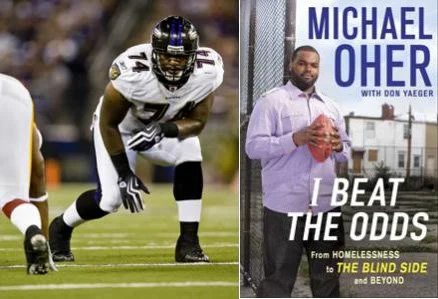
I Beat The Odds: From Homelessness to THE BLIND SIDE and Beyond
Michael Oher - ISBN: 978-1-592-40638-8 - 2011
Author:
Michael Oher played football for most of his life. He played in the NFL from 2009 to 2016 after being drafted by the Baltimore Ravens. Michael played left and right tackle during his career. Michael Lewis wrote “The Blind Side” about Michael and his extraordinary story of growing up in poverty, being taken in by the Tuohy family and finding his role in the offensive line. Michael has since retired after failing a physical following a nine month concussion protocol. I am sure he is concerned like most player about CTE. I cannot imagine how it feels to leave your profession and have to determine a new course in life so early.
Brief Synopsis:
Michael tells his story in his book, “I Beat The Odds.” This book recounts Michael’s childhood, adoption, college football career, and his draft day. The book also details the impact of the book and movie, The Blind Side, on his life. He also does a great job of revealing the world of the foster care system, his life in the projects of Memphis and how he overcame growing up in poverty.
Insights:
“Don't ever allow yourself to feel trapped by your choices. Take a look at yourself. You are a unique person created for a specific purpose. Your gifts matter. Your story matters. Your dreams matter. You matter.” - page 235
“People like to talk about "Cinderella stories," but Cinderella didn't get her happy ending without lifting a finger. She had to show up at the ball, be charming and smooth, and win over the prince. Of course she had help along the way, but ultimately it was up to her to make the fairy-tale ending happen.” - page 189
“It’s true that we can’t help the circumstances we’re born into and some of us start out in a much tougher place than other people. But just because we started there doesn’t mean we have to end there.” - page 235
Should I read it or skip it?
I chose this book for two reasons. First, I wanted to read it for Black History month. I felt like Michael’s knowledge of growing up in the poverty of the projects of Memphis and how the world around shaped his life would be a worthy read for Black History Month. Second, I wanted to get some insight into my son, Joshua. Like Michael, he plays offensive line. Josh lettered this last football season. As a sophomore, Josh played in every game both varsity and junior varsity. Josh and athletes like him are often a mystery to a band nerd and I thought I might get a glimpse of the competitive heart and understand him a little better. The offensive line is often a place without thanks. Normally, the only time you notice them is when something goes wrong.
I also think it important to acknowledge the impact of The Blind Side book and movie on Michael’s career. I will leave you to read how Michael believes it impacted him and whether he liked the movie and book. I think its important to see things through his eyes. Our race and our experiences can blind us to how he might have felt with the portrayal.

Book of the Month - January

The Post Quarantine Church
Thom Ranier - ISBN: 978-1496452757 - 2020
Author:
Thom Ranier served for many years as the CEO of Lifeway Christian Resources. More recently, he founded Church Answers and serves as CEO. He wants to bring health to churches and help them to work through difficult times. These last few years have seen huge challenges and hopefully, someone with 40 years of experience can help us all grow in a Post Quarantine environment.
Brief Synopsis:
Mr. Ranier identifies 6 Challenges and Opportunities for churches as we exit the quarantine caused by the COVID virus.
Gather Differently and Better
Seize your Opportunity to Reach the Digital World
Reconnect with the Community near Your Church
Take Prayer to a New and Powerful Level
Rethink your Facilities For Emerging Opportunities
Make Lasting Changes that will make a Difference
He takes each of these challenges and encourages church leaders with practical wisdom about how to use them as a springboard for the future.
Insights:
What if we asked the community how our church facilities could best serve them? - pg 17
At the core of many of these plans is a realization that churches must deal with three groups: what we’re calling digital only, digitally transitioning, and dual citizens. - pg 31
Two other early changes were obvious. First, more churches decided they could have worship services at times other than Sunday morning…Second, the online services that either began or were augmented during the quarantine are not going away. - pg 82
Should I read it or skip it?
I think this book provides a ton of insight in so few pages. At a little over 100 pages, Thom packs suggestions into every page and gives us a lot to consider. I think this would benefit every level. However, smaller churches might benefit more from reading together. Smaller or older churches tend to need encouragement in growing outside their norm. I think anyone would benefit from reading this book.

Missions Trip to Costa Rica

In the Summer of 2021, I received the opportunity to lead the Cross Mountain Missions Team to Fraijanes, Costa Rica. We thought we would be a bigger team. We thought we would be doing something amazing and hard. We were prepared for almost anything. We weren’t prepared for how this trip would impact us or how COVID would shape the team.
Before we ever left we ran into COVID. The team shrunk in the days before we left. People would call in and we would begin to make adjustments. Our church’s version of VBS the week before left us decimated. Kids and families showed up with the intent of getting out of the house. A year of not leaving drove everyone to find places where they could interact and have fun. We didn’t count on members of our team being exposed and not wanting to develop symptoms in a foreign country.

Senior Ayres, my fellow team lead, and Myself
We came for the opportunity to do something amazing. What we didn’t know was how we would be impacted by the events God conspired to create… Over the last few years, our church has developed a relationship with Pastor Roy Soto from Comunidad Cristiana Shalom. He has a vision to help kids in foster care and mothers reunite after they had come to know Christ and healed up. We found ourselves in Costa Rica following a sister church that had worked really hard to build the structure of the house where the foster kids would live.
What we didn’t know was the depth of sorrow we would see before we left. Pastor Roy received a call from the government asking him to take in a young lady from Nicaragua. She had crossed the border with her baby and had been found by the authorities. They brought her to the location we were staying. Our team got to eat with her and her baby. Our translator got to know her and for about 36 hours she found herself in limbo. In the end, the government separated her and her baby. We don’t know the end of the story but we do know, if the house had been ready, the baby could have stayed there while the mom was working through the process the government laid out for her. We were heartbroken for her as we watch the separation and the departure.
I am more convinced and believe in Pastor Roy’s ministry more now than ever. I also realized my need to learn Spanish and not have to depend on a translator. I cannot wait to go back and experience life with a group of people who are serving their community and making a difference!! Pura Vida!