

Danny’s Thoughts, Reviews, and Musings

Over-story: The Meta-Narrative of Scripture
Blog Series Intention Recap
This series will explore the grand story of Scripture—from Creation to Consummation—showing how every part of the Bible contributes to the overarching narrative of God’s redemption through Messiah. We will see the Father’s design for humanity to dwell with Him in covenant love and reflect His image in the world. Scripture reveals how God chose a people to carry His blessing and preserve the hope of salvation for all. From that people, Yeshua (Jesus) stands as the living center of Scripture, fulfilling every covenant and restoring fellowship between God and His creation. Finally, we see the complete over-story, as heaven and earth are renewed and the Father once again dwells with His redeemed people forever. From Genesis to Revelation, the same heartbeat sounds: “I will be their God, and they shall be My people.”
This post is the main page of the series “Over-story: The Meta-Narrative of Scripture.”

Week #4: The Table Is a Temple

Blog Series Intention Recap
This series invites readers to rediscover the rhythms of Shabbat as Jesus experienced them, revealing how ancient Jewish practices point to the rest, presence, and grace found in Messiah (Jesus). Each post unpacks a traditional element of Shabbat—beginning at sundown, candle lighting, spoken blessings, and shared meals—to show how they deepen our spiritual formation today. By exploring these practices, readers are equipped to follow Yeshua (Jesus) not only in belief but in the sacred rhythms of time, family, and worship.
This page is a post in the series “Dining with Jesus.” Click here to see the rest of the posts.
Let’s jump into Week #4:
The Table Is a Temple…The Shabbat table was the center of weekly worship in Jewish life, not the synagogue. In Yeshua(Jesus)’s ministry, the table becomes a place of transformation, hospitality, and healing. When we gather in His name, even our everyday meals become sacred spaces. Reclaim the holiness of the table. Set aside time to eat, pray, and connect with others—knowing that Yeshua (Jesus) still meets people not just in temples, but at tables.
Why it Matters:
The Shabbat table is the heart of Jewish worship—a place of blessing, community, and remembrance.
Yeshua (Jesus) used tables to reveal the kingdom of God, eating with sinners, teaching disciples, and sharing His presence.
The early church practiced "table fellowship", breaking bread together as a rhythm of faith and joy.
Your home table can become holy ground, where Yeshua (Jesus) is honored, relationships are built, and grace is shared.
Go Deeper:
“They broke bread in their homes and ate together with glad and sincere hearts, praising God...” —Acts 2:46–47 (NIV)
When we think of worship, we often picture rows of chairs, raised hands, and a preacher on a stage. But in the life of Yeshua (Jesus)—and in Jewish tradition—worship often happened around a table.
The Shabbat table, not the synagogue, was the spiritual center of the home. Each Friday evening, families would gather. Candles were lit. Blessings were spoken. Bread was shared. The table became a temple.
And in the Gospels, we see that Yeshua (Jesus) loved tables.
He taught at them. He welcomed strangers to them. He was criticized for who He ate with at them.
And in His final hours, He didn’t preach a sermon—He hosted a meal.
The table is not just where food is served—it’s where grace is received.
Shabbat: Worship Around the Table
Jewish Shabbat begins not at the synagogue, but at the table.
As sundown approaches on Friday, the household pauses. The woman of the home lights the candles. A prayer is spoken. Wine is poured. Bread is blessed. Songs are sung. Scriptures are read.
There is no rush. There is no performance.
It is holy, but it is homely. Sacred, but simple.
The table is set not just with food, but with faith.
The meal is not fast—it is slow and deliberate. It is a time of togetherness, gratitude, and memory. Parents bless children. Husbands honor wives. Everyone remembers who they are and whose they are.
And in that space, God is honored—not through liturgy alone, but through love and attention.
Yeshua (Jesus) at the Table
Throughout the Gospels, Yeshua (Jesus) is often found at the table.
He eats with tax collectors (Matthew 9:10).
He dines with Pharisees (Luke 7:36).
He breaks bread with His friends (Luke 24:30).
He tells parables about banquets and wedding feasts (Luke 14).
He feeds multitudes on hillsides (Mark 6:41).
And He prepares breakfast for His disciples after the resurrection (John 21:12).
Yeshua (Jesus) didn’t use the table as a reward for the holy.
He used it as an invitation for the hungry.
“The Son of Man came eating and drinking...” —Luke 7:34
Why?
Because meals are where life happens. And Yeshua (Jesus) came to meet us in the ordinary rhythms of life—not just the sacred ones.
He didn’t separate worship from dinner. He combined them.
He turned tables into places of healing, reconciliation, forgiveness, and joy.
And He still does.
The Early Church and the Sacred Meal
After Pentecost, the early believers didn’t build sanctuaries or plan conferences. They gathered in homes.
“And they devoted themselves to the apostles’ teaching and the fellowship, to the breaking of bread and the prayers...” —Acts 2:42 (ESV)
The phrase “breaking bread” refers not only to communion—but to shared meals. Table fellowship became a primary form of worship.
The home was the sanctuary.
The table was the altar.
The meal was the offering.
And the Spirit filled it all.
They didn’t need stages. They needed bread and blessing.
They didn’t wait for Sunday. They made every meal a moment to honor Yeshua (Jesus) and encourage one another.
Your Table Can Become a Temple
What if we reclaimed this?
What if our homes became centers of faith, not just places to crash?
What if our meals became acts of worship, not just quick refueling?
What if we invited people into our lives—not only to teach them truth, but to show them love?
You don’t need a seminary degree to be a host. You don’t need a perfect house to share a meal.
You just need a table and a willingness to welcome.
How does this help me understand, “Dining With Jesus?”
The Table Is Where the Kingdom Comes
In Luke 14, Yeshua (Jesus) told a parable about a banquet. Invitations were sent out. Many refused. So the master said:
“Go out to the highways and hedges and compel people to come in, that my house may be filled.” —Luke 14:23 (ESV)
God wants His table full.
He wants sinners and skeptics, children and elders, friends and neighbors.
Because the kingdom of God is not just a throne room—it is a dining room.
And Yeshua (Jesus) is still breaking bread with those who will welcome Him.
So set the table.
Light a candle.
Say a blessing.
And remember: this is where the kingdom begins.
How to Make Your Table Sacred
Try this simple pattern:
Light a candle before dinner as a signal: “This moment is set apart.”
Offer a blessing over the meal: “Thank You, Lord, for this food and these people.”
Read a short scripture (e.g., Psalm 23 or John 1:5).
Ask a simple question: “Where did you see God’s goodness today?”
Eat slowly. Talk honestly. Listen well.
Close with prayer: “Yeshua (Jesus), thank You for being here with us.”
When we do this, we’re not just eating—we’re dwelling in the presence of the Messiah.

Week #4: Why Not A Mid- or Post-Trib Rapture?

Blog Series Intention Recap
God has not destined the Church for wrath—and that truth changes everything.
This four-week series, Signs of the Times, explores the hope, clarity, and urgency that come with understanding the pre-tribulational rapture. In a world full of confusion and chaos, the return of Christ for His Bride is a promise that gives believers peace. Week by week, we’ll discover what the rapture is, why it must happen before the tribulation, how current events point toward the coming tribulation (not the rapture), and why alternative views like mid- or post-trib don’t align with Scripture. When we rightly understand God’s plan for the Church, we don’t panic—we prepare. This series will anchor your faith, fuel your mission, and help you live ready.
This page is a post in the series “Signs of the Times.” Click here to see the rest of the posts.
Let’s jump into Week #4:
Some say the Church will go through half or all of the tribulation. But Scripture says otherwise. The pre-trib rapture isn’t just a nice idea—it’s the only view that fits every promise, every prophecy, and every word of comfort Yeshua (Jesus) and Paul gave. Anything else puts the Church in the wrong place at the wrong time.
Why it Matters:
The rapture must be imminent. No signs can come before it.
The tribulation is God’s wrath. Believers are promised escape, not endurance.
The rapture brings comfort. Expecting judgment is not good news.
The Church is not Israel. The tribulation is for “Jacob’s trouble,” not Christ’s Bride.
Go Deeper:
Scripture Focus:
Matt. 24:42, 44
Revelation 6
1 Thessalonians 4:17-18
Not Appointed for Wrath, Not Left Behind to Suffer It
Why does this even matter? You may wonder, “Why does it matter when the rapture happens, as long as it does?”
Because timing affects everything:
Your understanding of God's promises
Your readiness for the future
Your message of hope to others
Your peace in the present
If we place the Church in the tribulation—whether part of it (mid-trib) or all of it (post-trib)—we replace comfort with fear, promise with uncertainty, and grace with judgment.
The Imminence Problem
The rapture is clearly presented in Scripture as something that can happen at any moment.
“Therefore stay awake… the Son of Man is coming at an hour you do not expect.” (Matthew 24:42, 44)
Paul never says, “Watch for the Antichrist,” or “Prepare for seven seals.” He says:
“We… who are alive… will be caught up… to meet the Lord.” (1 Thessalonians 4:17)
“Encourage one another with these words.” (v. 18)
Mid-trib and post-trib views require specific signs before the rapture can happen—like:
The rise of the Antichrist
The rebuilding of the temple
Global peace treaties
Massive martyrdoms
If signs must come first, then the rapture is not imminent. That contradicts everything Yeshua (Jesus) and Paul taught.
The Wrath Problem
Many people say, “Christians have always suffered. Why would we be spared now?”
But the tribulation is not normal suffering. It is the outpouring of God’s wrath on an unbelieving world.
Revelation 6:17 – “The great day of their wrath has come.”
Revelation 15:1 – “In them the wrath of God is finished.”
Revelation 16:1 – “Go and pour out… the seven bowls of the wrath of God.”
But believers are told:
“God has not destined us for wrath.” (1 Thess. 5:9)
“Jesus… delivers us from the wrath to come.” (1 Thess. 1:10)
“We have been justified… and saved from the wrath of God.” (Rom. 5:9)
If the Church is present during the tribulation, these verses become meaningless.
The Comfort Problem
In 1 Thessalonians 4:18 and 5:11, Paul says:
“Encourage one another with these words… Build one another up.”
Imagine telling a suffering believer:
“Good news! The Antichrist is coming soon, and you’re probably going to die horribly—but don’t worry, Yeshua (Jesus) comes later!”
That’s not comfort.
The rapture is meant to give peace.
Mid- and post-trib views give panic.
Only the pre-trib view allows for true hope and joy in the waiting.
The Distinction Problem
Another key issue: The Church is not Israel.
The Church began at Pentecost (Acts 2).
Israel began with Abraham.
The Church is the Bride of Christ.
Israel is God’s chosen nation.
The tribulation is described in Jeremiah 30:7 as “the time of Jacob’s trouble.” Jacob = Israel.
Daniel 9:24 says the 70 weeks (including the final week of tribulation) are for:
“your people and your holy city”—that’s Israel and Jerusalem.
God uses the tribulation to deal with Israel, not the Church. - The Church is removed before it begins.
Mid-Trib: Half Hope, Still Wrong
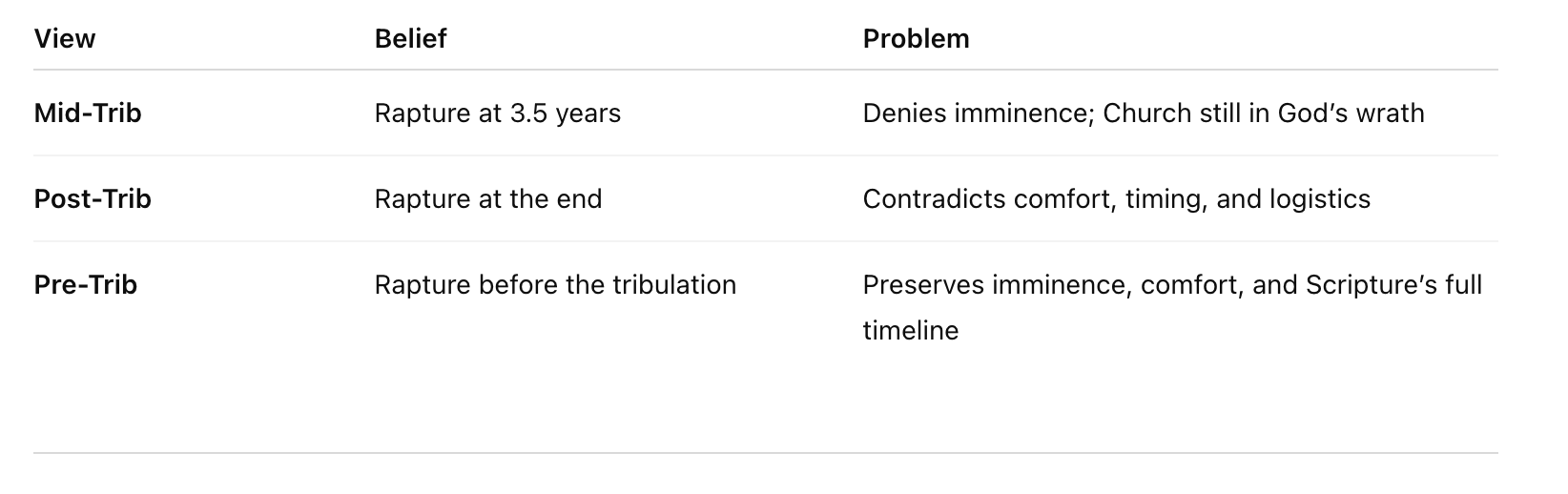
Mid-tribulationalism teaches that the rapture occurs 3.5 years into the seven-year tribulation—after the first wave of judgments, but before the most severe ones.
Problem? The whole tribulation is God’s wrath, from the very first seal (Rev. 6:1–2).
Yeshua (Jesus) opens the scroll.
Judgment begins right away.
Peace is taken from the earth (v. 4).
A quarter of the earth dies (v. 8).
Martyrs cry out under the altar (v. 10–11).
This is not just “the bad part” starting later. - It’s God’s judgment from day one.
Mid-trib still puts the Church under wrath. It denies the promise of rescue.
Post-Trib: No Time to Celebrate
Post-tribulationalism says the Church goes through the entire seven years, then is raptured and immediately returns with Christ.
So… we go up, and come straight back down?
That doesn’t match what Yeshua (Jesus) said:
“I will come again and will take you to myself, that where I am you may be also.” (John 14:3)
That’s a gathering to heaven, not a U-turn to earth.
Also, in post-trib theology:
There’s no time for the Judgment Seat of Christ.
There’s no time for the Marriage Supper of the Lamb.
There’s no population left to enter the Millennial Kingdom.
It just doesn’t fit.
Visual Comparison
Here’s a quick comparison of all three views:
The Bride and the Groom
The Church is the Bride of the Messiah. Scripture uses the image of a Jewish wedding to describe our relationship with Yeshua (Jesus).
In that model:
The groom prepares a place for the bride.
He comes suddenly to take her home.
The bride doesn’t know the day.
They celebrate for seven days.
Yeshua (Jesus) said:
“I go to prepare a place for you… I will come again and take you to myself.” (John 14:2–3)
Would the Groom beat His Bride before the wedding? Of course not.
The Church doesn’t face the tribulation. We face our Bridegroom.
How does this help me understand “The Signs of the Times?”
Be Anchored in Truth
Knowing the truth about the rapture keeps you grounded. You’re not drifting in fear. You’re anchored in promise.
You don’t fear the Antichrist—you long for Yeshua (Jesus).
You don’t dread the future—you trust in your Deliverer.
You don’t panic—you prepare others.
Confusion is the enemy of comfort. But truth gives peace.
Don’t just win arguments—win souls.
Understanding why the rapture is pre-tribulational should stir you, not just inform you.
Here’s how to respond:
Be clear. Don’t apologize for hope. Stand firm on God’s Word.
Be kind. Others may disagree—be gentle, not arrogant.
Be confident. God finishes what He starts. He will rescue His Bride.
Be active. Time is short. Preach the gospel. Encourage the Church.
The rapture is not a puzzle to solve—it’s a promise to cherish. It’s about rescue, not ruin. Hope, not horror. A Groom, not a tyrant. God has not destined you for wrath. He has destined you for glory. So lift your eyes, strengthen your faith, and share the hope.
Yeshua (Jesus) is coming. And He’s coming before the storm.
Week #3: The Storm Is Coming—But We Leave Before It Hits
Blog Series Intention Recap
God has not destined the Church for wrath—and that truth changes everything.
This four-week series, Signs of the Times, explores the hope, clarity, and urgency that come with understanding the pre-tribulational rapture. In a world full of confusion and chaos, the return of Christ for His Bride is a promise that gives believers peace. Week by week, we’ll discover what the rapture is, why it must happen before the tribulation, how current events point toward the coming tribulation (not the rapture), and why alternative views like mid- or post-trib don’t align with Scripture. When we rightly understand God’s plan for the Church, we don’t panic—we prepare. This series will anchor your faith, fuel your mission, and help you live ready.
This page is a post in the series “Signs of the Times.” Click here to see the rest of the posts.
Let’s jump into Week #3:
The rapture will happen without warning. But that doesn’t mean nothing is happening now. Scripture shows us that while the rapture is signless, the stage is being set for the tribulation. What we see today are not rapture signs—they are tribulation signs casting shadows backward.
Why it Matters:
The rapture has no signs. It could happen at any moment.
The tribulation has many signs. They’re already beginning to appear.
The Restrainer still holds back evil. When He is removed, judgment begins.
The signs show the world is being prepared. We don’t fear—we focus.
Go Deeper:
Scripture Focus:
2 Peter 3:9
1 Thessalonians 4:17
2 Thessalonians 2:1–7
Not Every Sign Points to the Rapture
Many people today are asking, “Are we in the end times?”
It’s a fair question. There are wars, famines, earthquakes, and hatred like never before. But before we answer that, we need to ask a better question:
What are we looking for—the rapture or the tribulation?
Let’s be clear: the rapture comes with no signs. It’s imminent. That means it could happen at any time—today, tomorrow, or years from now.
But the tribulation? That’s different. Yeshua (Jesus) gave signs for it. Paul gave warnings. Revelation shows the timeline.
So when we see signs increasing in the world, we’re not seeing rapture signs—we’re seeing tribulation signs.
Matthew 24 Is Not About the Rapture
Many people quote Matthew 24 to describe the rapture. But that’s not what Yeshua (Jesus) is talking about there.
Let’s look at the context.
The disciples ask, “What will be the sign of your coming and of the end of the age?” (Matthew 24:3)
Yeshua (Jesus) lists wars, famines, earthquakes, lawlessness, false prophets, and the preaching of the gospel.
But notice: Yeshua (Jesus) is not talking about meeting us in the air (1 Thess. 4:17). He’s talking about His return to earth in glory and judgment.
Matthew 24 is about the Second Coming, not the rapture. It outlines what will happen after the rapture—during the tribulation.
2 Thessalonians: The Restrainer Holds Back
Paul clarifies this even more in 2 Thessalonians 2:1–7.
The believers were worried they had missed the rapture. Paul calms them:
“Let no one deceive you… that day will not come, unless the rebellion comes first, and the man of lawlessness is revealed…” (v. 3)
That “man of lawlessness” is the Antichrist.
But what’s stopping him from appearing now?
“You know what is restraining him now… He who now restrains it will do so until he is out of the way.” (v. 6–7)
This Restrainer is the Holy Spirit working through the Church. When the Church is raptured, the Restrainer is removed—and evil will explode on earth.
The fact that evil is already rising shows the pressure is building.
The Signs Are Foreshadows
Imagine watching the actors walk on stage before the curtain rises. You see costumes, hear whispers, feel the energy.
That’s where we are now.
Geopolitical instability – Nations rising against nations.
Moral confusion – Good called evil, and evil called good.
Technology for control – Tools for the mark of the beast already exist.
Hatred of Israel – The world increasingly turns against God’s chosen people.
One-world thinking – Global crisis creating global solutions.
All of this is not the tribulation yet—but it’s preparing for it. It’s the shadow before the storm.
Israel at the Center
Another key sign is the spotlight on Israel. The nation of Israel was reborn in 1948. That alone fulfilled prophecy. No other nation has disappeared for 2,000 years and come back. But Israel did—because God said it would.
The tribulation is centered on Israel. The temple will be rebuilt. Sacrifices will resume. The Antichrist will break a peace treaty and desecrate the holy place.
None of that happens without Israel in place. And now it is.
When you watch the headlines, keep an eye on Israel. That’s God’s timepiece.
Yeshua (Jesus) Said to Watch
In Luke 21:28, Yeshua (Jesus) says:
“Now when these things begin to take place, straighten up and raise your heads, because your redemption is drawing near.”
We’re not told to guess dates or panic. We’re told to look up.
Why? Because the closer we get to the tribulation, the closer we are to the rapture.
If we’re already seeing signs meant for after the rapture, then how soon must the rapture be?
Don’t Confuse the Timeline
Some believers mix up the rapture and Second Coming. Here’s a helpful chart:
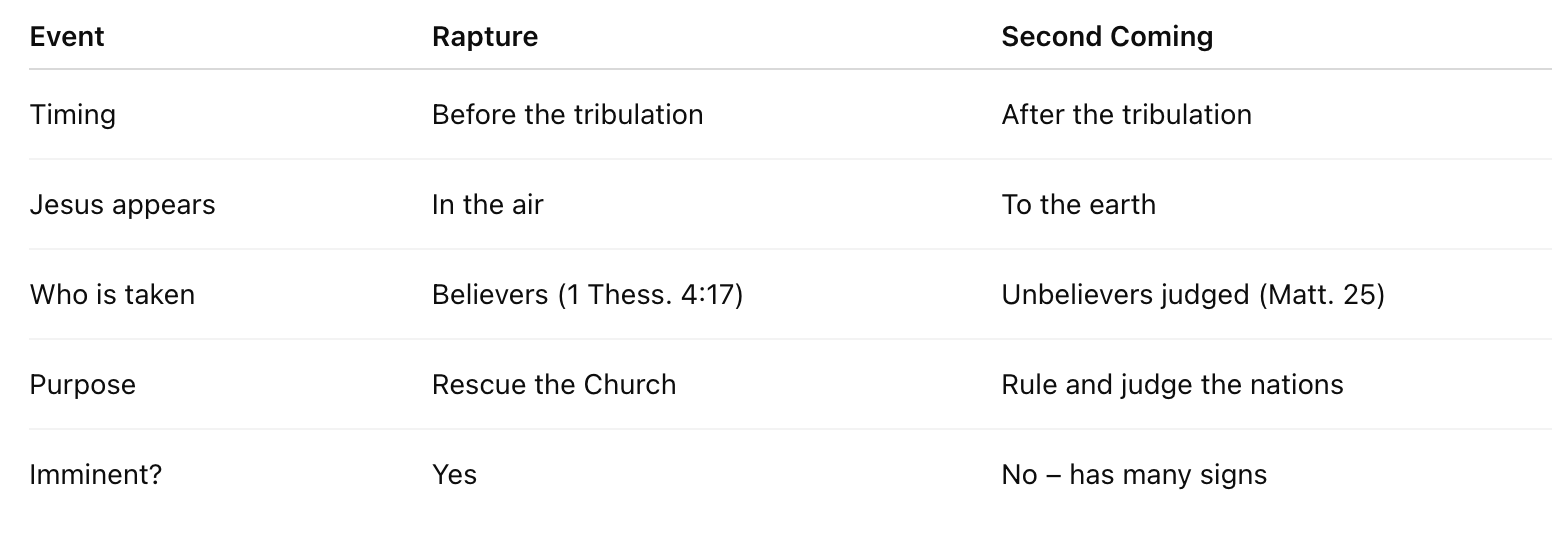
Don’t merge what God separates. The rapture is a private reunion. The Second Coming is a public return.
People Will Mock
Peter warned that people would laugh at the idea of Yeshua (Jesus) coming back:
“Scoffers will come… saying, ‘Where is the promise of his coming?’” (2 Peter 3:3–4)
They’ll say, “It’s always been this way.” They’ll point to failed predictions. They’ll call it fantasy. Don’t let that shake you. Mockers prove the Bible right. And their mocking shouldn’t silence us—it should sharpen us.
Why God Delays
You might wonder, “If things are this bad, why hasn’t Yeshua (Jesus) come yet?”
Peter answers that too:
“The Lord is not slow… but is patient toward you, not wishing that any should perish, but that all should reach repentance.” (2 Peter 3:9)
God is waiting—not because He’s unsure, but because He’s merciful.
Every day He waits is a chance for more people to repent and believe.
But that window won’t stay open forever.
How does this help me understand “The Signs of the Times?”
Don’t Just Read the Signs—Respond
The signs before the tribulation aren’t meant to scare us. They’re meant to stir us.
We’re not looking for the Antichrist—we’re looking for Messiah Yeshua (Jesus).
We’re not prepping to endure judgment—we’re prepping to escape it.
We’re not paralyzed by fear—we’re activated by faith.
So lift your eyes. Check your heart. Open your mouth. Because the world is ready for wrath… but the Church is ready for rescue.
If the signs are here, and the time is short, how do we live?
Be Alert.
Stay awake to what’s happening in the world and in your own life.Be Pure.
Live holy. Don’t let sin lull you into sleep. Yeshua (Jesus) is coming.Be Bold.
Tell people the truth. The gospel is urgent. Time is running out.Be Encouraged.
God’s not caught off guard. He told us this would happen. And He’s coming to get us before it breaks loose.
The signs of the times are not the rapture—they’re what follows it.
But if the world is already preparing for the tribulation…
Then heaven is already preparing for our arrival.
Don’t miss your moment. - Yeshua (Jesus) is coming.
Week #2: The Church and God’s Wrath Don’t Mix
Blog Series Intention Recap
God has not destined the Church for wrath—and that truth changes everything.
This four-week series, Signs of the Times, explores the hope, clarity, and urgency that come with understanding the pre-tribulational rapture. In a world full of confusion and chaos, the return of Christ for His Bride is a promise that gives believers peace. Week by week, we’ll discover what the rapture is, why it must happen before the tribulation, how current events point toward the coming tribulation (not the rapture), and why alternative views like mid- or post-trib don’t align with Scripture. When we rightly understand God’s plan for the Church, we don’t panic—we prepare. This series will anchor your faith, fuel your mission, and help you live ready.
This page is a post in the series “Signs of the Times.” Click here to see the rest of the posts.
Let’s jump into Week #2:
The Church won’t go through the tribulation—because God says so. Scripture clearly teaches that the seven-year tribulation is not for the Church. It's a time of wrath, judgment, and refining—but not for the Bride of Christ. Believers are promised rescue, not wrath.
Why it Matters:
Wrath is not for us. God’s judgment falls on the world, not His Church.
We’re kept from the hour. Yeshua (Jesus) promises protection, not just endurance.
The Church is not Israel. The tribulation is for Jacob’s trouble, not the Church’s purification.
God’s Word gives us peace. Knowing we’re safe brings strength and focus.
Go Deeper:
Scripture Focus:
Revelation 3:10
1 Thessalonians 5
Romans 5:9
Why Pre-Trib? The Difference Between Trouble and Wrath
Believers have always faced trouble—Yeshua (Jesus) even said, “In this world you will have tribulation” (John 16:33). But that’s very different from The Tribulation.
Little “t” tribulation = normal trials of life in a broken world.
Big “T” Tribulation = God’s direct judgment on a rebellious world (Revelation 6–19).
The Church may face pressure, persecution, and hardship. But it is not appointed to face God’s wrath.
“For God has not destined us for wrath, but to obtain salvation through our Lord Jesus Christ.”
—1 Thessalonians 5:9 (ESV)
Let that settle into your heart: not destined for wrath.
The Promise of Rescue
Some people think God will protect the Church through the tribulation. But Revelation 3:10 says something different:
“Because you have kept my word about patient endurance, I will keep you from the hour of trial that is coming on the whole world.”
—Revelation 3:10 (ESV)
Look closely: Yeshua (Jesus) promises to keep us from the hour, not just the trial. This is about timing, not just protection.
The Greek phrase “keep from” is ἐκ (ek)—it means “out of” or “away from,” not “through.” If God meant to say we would be protected during the tribulation, He would’ve used a different word.
Yeshua (Jesus) is saying clearly: You won’t be here.
The Nature of the Tribulation
So what is the tribulation really?
It’s not just a bad time. It’s the outpouring of God’s wrath on a world that has rejected Him. Revelation 6–19 describes:
Seal judgments
Trumpet judgments
Bowl judgments
Cosmic chaos
Demonic torment
Global war
Widespread death
It is not just persecution from people. It is judgment from heaven.
Revelation 6:16–17 calls it:
“the wrath of the Lamb… for the great day of their wrath has come.”
If that’s what’s coming—and it is—then the question becomes: Why would Yeahua (Jesus) leave His Church in it? He won’t.
Romans Says It, Too. The book of Romans makes the same point. Look at Romans 5:9:
“Since, therefore, we have now been justified by his blood, much more shall we be saved by him from the wrath of God.”
We’re not just forgiven—we’re rescued. Yeshua (Jesus) took God’s wrath on Himself so we wouldn’t have to face it. The cross wasn’t just a payment. It was also a shield. If you’re in Messiah, you are safe.
Israel and the Church: Not the Same
A lot of confusion comes from mixing up Israel and the Church.
God has one plan of salvation, but two distinct groups:
Israel: The chosen people, through whom the Messiah came.
The Church: Jew and Gentile united in Messiah, formed at Pentecost.
The tribulation is called “the time of Jacob’s trouble” (Jer. 30:7). That’s not the Church’s trouble. That’s Israel’s.
God uses the tribulation to:
Judge the nations (Isaiah 24)
Refine and bring Israel to faith (Zechariah 13:8–9)
Set the stage for the Messiah’s kingdom (Daniel 9:24–27)
The Church has a different calling: to be the Bride of Messiah and be with Him before He judges the earth.
The Thessalonian Timeline
Let’s go back to 1 Thessalonians 5. Paul continues his rapture teaching and connects it to the “Day of the Lord.”
That Day will come like a thief (v. 2)
People will say “peace and safety,” then sudden destruction comes (v. 3)
But believers are not in darkness (v. 4)
The message is clear: You’re not in the dark, and you’re not in danger. Why?
“For God has not destined us for wrath, but to obtain salvation…” (v. 9)
That’s the same context as the rapture (chapter 4). Paul’s teaching is seamless. The rapture comes, then the wrath falls. We’re removed before the storm begins.
Comfort, Not Confusion
If the Church was going to go through the tribulation, the message would be: Brace yourself! Stock up! Prepare for death and disaster!
But what does Paul say?
“Therefore encourage one another and build one another up…” (1 Thess. 5:11)
And earlier:
“Therefore encourage one another with these words.” (1 Thess. 4:18)
The rapture is not a scary doctrine. It’s a comforting one. God does not call us to fear the wrath. He calls us to wait for our rescue.
Two Scenes, Two Audiences
Let’s compare two pictures in the book of Revelation.
Scene 1: The Church in Heaven
In Revelation 4–5, the Church is depicted in heaven, worshiping, wearing white robes, and singing of redemption.Scene 2: Wrath on Earth
In Revelation 6–19, God’s wrath is poured out on the earth. Israel becomes the focus. The Church is never mentioned again until it returns with Messiah in chapter 19.
Why the silence? Because the Church is gone.
What About the Holy Spirit?
2 Thessalonians 2:6–7 talks about a “restrainer” that holds back the rise of the Antichrist. That restrainer is the Holy Spirit working through the Church.
Once the Church is removed at the rapture, the restrainer is lifted—and the tribulation begins.
That’s the sequence:
The Church is raptured.
The Antichrist is revealed.
God’s wrath begins.
This fits the entire prophetic pattern.
How does this help me understand “The Signs of the Times?”
Live in Peace, Not Panic
You don’t have to wonder if you’ll survive the tribulation.
You won’t be here.
That doesn’t mean we sit around and wait. It means we:
Live with peace – God is in control, and you’re safe in Him.
Walk with purpose – Time is short. Share the gospel.
Stand with hope – Let your light shine in a dark world.
Yeshua (Jesus) is not coming back to crush you. He’s coming to carry you home.
Real Wrath Requires Real Rescue
Some say, “Well, Christians suffer in other countries. Why not here?”
It’s true—we live in a fallen world. Believers are persecuted, hated, and even killed for their faith. That’s man's wrath and Satan’s rage.
But the tribulation is God’s wrath. And Scripture is clear:
“Whoever believes in him is not condemned…” (John 3:18)
“There is therefore now no condemnation for those who are in Messiah Yeshua (Jesus).” (Romans 8:1)
God does not pour His wrath on His own children. He rescues them first.
The pre-tribulational rapture isn’t just a theory—it’s a gift.
It tells us:
God keeps His promises.
God doesn’t mix judgment with grace.
God is still working His plan for Israel.
God has a glorious future for His Church.
We are not appointed for wrath. We are appointed for salvation.
So when the world shakes, you don’t have to. Your rescue is coming.
Week #1: What Is the Rapture?
Blog Series Intention Recap
God has not destined the Church for wrath—and that truth changes everything.
This four-week series, Signs of the Times, explores the hope, clarity, and urgency that come with understanding the pre-tribulational rapture. In a world full of confusion and chaos, the return of Christ for His Bride is a promise that gives believers peace. Week by week, we’ll discover what the rapture is, why it must happen before the tribulation, how current events point toward the coming tribulation (not the rapture), and why alternative views like mid- or post-trib don’t align with Scripture. When we rightly understand God’s plan for the Church, we don’t panic—we prepare. This series will anchor your faith, fuel your mission, and help you live ready.
This page is a post in the series “Signs of the Times.” Click here to see the rest of the posts.
Let’s jump into Week #1:
He’s Coming to Take Us Home… The rapture is not a myth or mystery—it’s an absolute promise from Yeshua (Jesus). One day, without warning, He will return for His Church and take us to be with Him. This is not the end of the world, but the beginning of forever for those who belong to Christ.
Why it Matters:
It’s a rescue mission. Yeshua (Jesus) will remove His Church before the coming judgment.
It’s a real event. The rapture is different from the Second Coming.
It’s a comforting hope. Believers should encourage one another with this truth.
It could happen anytime. No signs are needed first—be ready.
Go Deeper:
Scripture Focus:
John 14:1-3
1 Thessalonians 4:13–18
The Promise You Can’t Miss
Life is filled with surprises—some good, some hard. But for the believer in Yeshua (Jesus), there is one surprise we are meant to look forward to every day. It’s called the rapture.
Yeshua (Jesus) made a promise in John 14:1-3. He told His disciples:
“Let not your hearts be troubled. Believe in God; believe also in me. In my Father’s house are many rooms… I go to prepare a place for you… I will come again and will take you to myself, that where I am you may be also.” (John 14:1–3, ESV)
This is more than comfort—it’s a clear promise. Yeshua (Jesus) will come back, not to judge the world (yet), but to take His people—His Church—to be with Him.
What Is the Rapture?
The word “rapture” doesn’t appear in English Bibles. But it comes from the Latin word rapturo, which translates the Greek word harpazō in 1 Thessalonians 4:17:
“…we who are alive, who are left, will be caught up together with them in the clouds to meet the Lord in the air…”
That phrase “caught up” is harpazō—to grab quickly, to snatch away with force. That’s what the rapture is. Yeshua (Jesus) will come down from heaven (but not touch the earth) and call up His Church.
Let’s be clear: this is not the Second Coming.
The Second Coming happens at the end of the tribulation (Revelation 19).
The rapture happens before the tribulation begins.
In the rapture, Yeshua (Jesus) meets us in the air.
In the Second Coming, Yeshua (Jesus) returns to earth to rule.
These are two different events. Don’t mix them up.
What Happens at the Rapture?
Paul gives us the details in 1 Thessalonians 4:13–18.
Believers who have died will rise first.
Then we who are still alive will be caught up with them.
We will meet Yeshua (Jesus) in the air.
We will always be with the Lord.
That means the rapture includes a resurrection. It’s not just a relocation—it’s a transformation. Believers get new, glorified bodies. No more sickness, death, or sin.
And the best part? We’ll never be apart from Yeshua (Jesus) again.
Why It Matters
You might be asking, “Why do I need to know this?”
Here’s why:
It changes how we grieve.
Paul wrote these words to comfort believers whose loved ones had died. He didn’t say, “Don’t cry.” He said, “We don’t grieve as others do who have no hope.” (1 Thess. 4:13)
If someone you love died in Christ, they’re not lost forever. You’ll see them again.It gives us peace in a scary world.
From wars to disasters to hatred and chaos, this world is shaking. But the rapture reminds us: we’re not staying here. Yeshua (Jesus) is coming.It motivates holiness.
If Yeshua (Jesus) could return today, how would you live? Would you stay angry? Would you keep that secret sin? Would you stop sharing the gospel?It helps us encourage others.
1 Thessalonians 4:18 says, “Therefore encourage one another with these words.” The rapture isn’t meant to scare us. It’s intended to stir us.
5. Common Questions
Q: What if I don’t believe in the rapture?
A: The rapture isn’t a theory—it’s a teaching straight from Scripture. Whether you believe it or not, it will happen. The real question is: Are you ready?
Q: Doesn’t this just make Christians lazy?
A: No. The opposite should be true. Knowing that Yeshua (Jesus) could return at any time should make us alert, focused, and bold.
Q: Isn’t the idea of being “snatched away” strange?
A: It might sound strange, but it’s not new. Enoch (Genesis 5:24) and Elijah (2 Kings 2:11) were both taken up to heaven without experiencing physical death. God has done this before. He will do it again.
Q: Why don’t more pastors teach about this?
A: Some avoid it because it’s hard to explain. Others reject it because they confuse the rapture with the Second Coming. Still others just focus on the here and now. But Scripture tells us to be watchful.
No Signs, Just Readiness
Many prophecies in the Bible are tied to clear signs. But the rapture is different.
There are no prerequisites that must be met first. This is called imminence—the idea that Yeshua (Jesus) could come at any moment.
If signs had to happen first, then we could wait. But Yeshua (Jesus) says, “Be ready, for the Son of Man is coming at an hour you do not expect.” (Matt. 24:44)
So don’t wait to repent. Don’t delay your calling. Don’t put off reconciliation.
The Church Is the Bride
One more reason the rapture is pre-tribulational (before the seven-year tribulation): the Church is the Bride of Christ.
Would a groom beat his bride before the wedding?
Would Yeshua (Jesus) leave His Bride to suffer God’s wrath?
Of course not.
The tribulation is not just suffering—it is judgment from God on a rebellious world and a time of refinement for Israel (Jeremiah 30:7). But the Church is not destined for wrath (1 Thess. 5:9). We will be removed before the storm.
How does this help me understand “The Signs of the Times?”
Live ready.
The return of Yeshua (Jesus) could happen at any moment. Don’t panic—prepare. Don’t delay—decide. Don’t sleep—stay awake.
This doctrine shouldn’t just fill your head. It should shape your life.
Here’s how to live ready:
Believe in Yeshua (Jesus).
Make sure you know Him—not just know about Him. Repent and trust Him alone.Stay awake.
Don’t fall asleep spiritually. Read the Word. Pray. Stay alert.Share the gospel.
If time is short, we must speak the truth. Love people enough to tell them.Encourage others.
When someone is hurting, afraid, or grieving—remind them: Yeshua (Jesus) is coming.
Encourage one another with this blessed hope.
The rapture is not the end of the story. It’s the beginning of eternity with Yeshua (Jesus).
This world is not our home. We’re waiting for the trumpet. We’re looking for the cloud. We’re listening for the shout.
One day soon—maybe even today—Yeshua (Jesus) will say, “Come up here.”
And just like that, we’ll be gone.
Not because we’re perfect.
Not because we’re lucky.
But because we belong to Him.

Signs of the Times
Blog Series Intention Recap
God has not destined the Church for wrath—and that truth changes everything.
This four-week series, Signs of the Times, explores the hope, clarity, and urgency that come with understanding the pre-tribulational rapture. In a world full of confusion and chaos, the return of Christ for His Bride is a promise that gives believers peace. Week by week, we’ll discover what the rapture is, why it must happen before the tribulation, how current events point toward the coming tribulation (not the rapture), and why alternative views like mid- or post-trib don’t align with Scripture. When we rightly understand God’s plan for the Church, we don’t panic—we prepare. This series will anchor your faith, fuel your mission, and help you live ready.
This post is the main page of the series “Signs of the Times.”

Week #4: The Root of Antisemitism

Blog Series Intention Recap
This series, IRREPLACEABLE, confronts the theological error of Replacement Theology by affirming God’s ongoing covenant with Israel. The Bible teaches that the Church and Israel remain distinct in God’s redemptive plan. Though the Church currently plays a central role in the age of grace, Israel is not forgotten—she remains God’s chosen nation, awaiting future restoration in the Millennial Kingdom. The Apostle Paul’s words in Romans 11 ring clear: God’s promises to Israel are irrevocable—and so is His plan. Throughout this four-week study, we will clarify the Church’s proper role, expose the roots of antisemitism, and uphold God’s faithful commitment to Israel’s future. The Church does not replace Israel—it joins her in displaying the glory of God’s unfailing mercy.
This page is a post in the series “Irreplaceable: Israel’s Place in God’s Plan.” Click here to see the rest of the posts.
Let’s jump into Week #4:
Right theology leads to right love… Antisemitism is not just a cultural problem—it’s a theological one. Replacement theology has fueled hostility toward the Jewish people for centuries by severing the Church from its Jewish roots. To stand with Israel is not political—it’s biblical. When we affirm God’s ongoing covenant with Israel, we resist hatred and reflect the heart of God.
Why it Matters:
Bad Theology Breeds Bad Fruit
When the Church believes God is done with Israel, it opens the door to arrogance, distortion, and abuse.History Bears Witness
From the early church fathers to the Holocaust, antisemitism often grew in soil nourished by replacement theology.Yeshua (Jesus) Was Jewish—And Still Is
Forgetting the Jewish identity of our Savior creates space for anti-Jewish bias to flourish.Love What God Loves
To honor God is to honor His covenant people, to bless them, and to stand against those who curse them.
Go Deeper:
Scripture Focus:
Genesis 12:3 (ESV)
“I will bless those who bless you, and him who dishonors you I will curse, and in you all the families of the earth shall be blessed.”Romans 11:18–21
Paul warns Gentile believers not to be arrogant toward the natural branches (Israel). If God did not spare the natural branches, neither will He spare the arrogant.John 4:22
Yeshua (Jesus) says, “Salvation is from the Jews.”
The Root of Antisemitism
Antisemitism is once again rising—online, on college campuses, and even in churches. But this is not a new phenomenon. For centuries, the Church has often been complicit in spreading suspicion, slander, and even violence against the Jewish people. What fueled this long history of hostility? Bad theology. Theological error—particularly the teaching that God has rejected Israel and replaced her with the Church—has poisoned the well for generations. This error, known as replacement theology, is more than a doctrinal misstep. It is the seedbed of arrogance, distortion, and abuse.
Bad Theology Breeds Bad Fruit.
When the Church teaches that Israel is no longer central to God's plan, it opens the door to pride. It gives believers a false sense of superiority. It allows the Church to forget its roots and assume ownership of promises never made to her. And when pride takes root, persecution is often not far behind.
History Bears Witness.
From the writings of early Church Fathers like John Chrysostom, who preached vehemently against Jews, to Martin Luther’s horrific antisemitic diatribes late in life, the pattern is undeniable. During the Holocaust, far too many churches remained silent—or worse, justified inaction with theological reasoning. Replacement theology offered the ideological cover for centuries of marginalization and mistreatment. What began in error led to injustice.
Yeshua (Jesus) Was Jewish—and Still Is.
Forgetting the Jewish identity of our Savior creates space for anti-Jewish bias to flourish. Yeshua (Jesus) was not a generic religious figure. He was born into a Jewish family, lived as a Jew, taught in synagogues, upheld the Law, and died as “King of the Jews.” He rose again as the Jewish Messiah and will return to reign from Jerusalem. To erase His Jewishness is to distort His mission and disfigure the gospel.
Love What God Loves.
To honor God is to honor His covenant. That includes the people of that covenant. Genesis 12:3 makes it clear: those who bless Abraham’s descendants will be blessed, and those who curse them will face God’s judgment. Standing with Israel is not about political alignment—it is about spiritual alignment with the heart of God. The Jewish people are not merely part of the past—they are part of the promise.
The Church’s Role
When theology severs the Church from Israel, it leads to pride. That pride often evolves into contempt and persecution. Replacement theology does not simply reinterpret Scripture; it rewrites identity. And in doing so, it fuels the very antisemitism it claims to avoid. But God has not changed. His promises still stand. His covenant remains. Israel is not cast aside but remains central to God’s redemptive plan.
The Church must repent of its past complicity and resist the resurgence of antisemitism in any form. This is not just a social issue—it is a theological one. Antisemitism is spiritual rebellion against the character of a covenant-keeping God. The cure is not found in tolerance alone—it is found in truth. It is found in remembering what Scripture reveals, repenting where we have gone astray, and returning to a theology that honors God’s Word and His people.
Remember the Root
Romans 11 paints a clear picture: Gentile believers are not a separate tree—they are branches grafted into Israel’s olive tree. That means Israel’s story is the Church’s story—not because we replace it, but because we are now included in it. Paul explicitly warns against arrogance: “do not be arrogant toward the branches” (Rom. 11:18). We do not support the root; the root supports us.
Jesus was born a Jew, lived as a Jew, died as the King of the Jews, and will return to Jerusalem. The gospel is Jewish in origin, and the Church only exists because of the promises made to the patriarchs. The covenants, the law, the prophets, the Messiah—they all came through Israel (Rom. 9:4–5). To despise or dismiss Israel is to despise our own foundation.
When the Church forgets this, it creates space for pride, prejudice, and ultimately persecution. But when we remember our place in the story, we walk humbly. We honor what God honors. We bless whom God blesses. And we love what God loves—not in theory, but in action, prayer, and partnership.
Right theology leads to right love. And right love takes a stand.
How does this help me understand, “Irreplaceable: Israel’s Place in God’s Plan?”
Our Right Response
Scripture guides the Church to confront the theological roots of antisemitism. When we reject replacement theology and embrace God’s faithfulness to Israel, we align with His heart and resist hatred. The Jewish people are not forgotten—they are beloved. Right theology leads to right love. And right love stands up.
So how should the Church respond?
Understanding the theological roots of antisemitism calls for repentance, education, and love in action. Here’s how:
1. Repent of Arrogance
Where the Church has participated in or been silent about antisemitism, we must repent. That includes theology, history, and attitudes.
2. Teach the Whole Story
Educate believers about the Jewish roots of the faith. Let them see that the Bible is a Jewish book, the Messiah is Jewish, and God’s plan centers on Israel.
3. Stand with Israel
This isn’t about agreeing with every political decision—it’s about honoring God's covenant. Be a friend to the Jewish people in prayer, presence, and support.
4. Confront Antisemitism
Wherever antisemitism appears—whether in theology, culture, or conversation—stand against it boldly and biblically.
“Irreplaceable” is more than a title—it’s a conviction rooted in God’s Word. Israel remains God’s chosen people, and the Church’s calling is to join—not overwrite—the redemptive story. Right theology protects against error, pride, and prejudice. Let us walk in humility, bless what God blesses, and remember that God never breaks a promise.
Week #3: God’s Plan Still Includes the Jews
Blog Series Intention Recap
This series, IRREPLACEABLE, confronts the theological error of Replacement Theology by affirming God’s ongoing covenant with Israel. The Bible teaches that the Church and Israel remain distinct in God’s redemptive plan. Though the Church currently plays a central role in the age of grace, Israel is not forgotten—she remains God’s chosen nation, awaiting future restoration in the Millennial Kingdom. The Apostle Paul’s words in Romans 11 ring clear: God’s promises to Israel are irrevocable—and so is His plan. Throughout this four-week study, we will clarify the Church’s proper role, expose the roots of antisemitism, and uphold God’s faithful commitment to Israel’s future. The Church does not replace Israel—it joins her in displaying the glory of God’s unfailing mercy.
This page is a post in the series “Irreplaceable: Israel’s Place in God’s Plan.” Click here to see the rest of the posts.
Let’s jump into Week #3:
He has not rejected His people—He remembers His promises… God has not abandoned Israel, and He never will. His covenant with them was not temporary or conditional—it was established by His faithfulness, not their performance. Though many have stumbled, His love remains steadfast, and every promise will come to pass in His perfect timing. The Jewish people are not a footnote in redemption’s story; they are central to its fulfillment, especially as the return of the Messiah draws near.
Why it Matters:
God Keeps His Promises - From Abraham to today, God has never revoked His covenant with Israel.
Paul’s Clear Answer: No! - In Romans 11:1, Paul asks, “Has God rejected His people?” and immediately answers, “By no means!”
A Partial Hardening, Not a Final Rejection - Romans 11:25 explains that Israel’s current unbelief is temporary and purposeful.
Their Future Acceptance Means Life from the Dead - God’s plan includes a national return to faith—and it will bless the world.
Go Deeper:
Scripture Focus:
Romans 11:1–2a (ESV)
"I ask, then, has God rejected his people? By no means! For I myself am an Israelite, a descendant of Abraham, a member of the tribe of Benjamin. God has not rejected his people whom he foreknew."Jeremiah 31:35–37
God declares that only if the fixed order of the sun, moon, and stars can be measured or broken will He cast off the descendants of Israel. His covenant with them is unbreakable.Zechariah 12:10
There is coming a day when the house of David and the inhabitants of Jerusalem will look on the One they have pierced and mourn—a prophetic picture of Israel’s national repentance.
"By no means!"
Many modern Christians have embraced the idea that Israel no longer matters to God—that the Church is the new Israel. But Scripture says otherwise. Paul’s rhetorical question in Romans 11:1 leaves no doubt: "By no means!" God’s faithfulness to Israel isn’t just a side issue—it’s central to understanding His character. If God can cancel His covenant with Israel, what assurance do we have that He’ll keep His promises to the Church?
This theological clarity is especially important in our time. As antisemitism rises and Israel’s place in the world is debated, the Church must stand firm on what God has declared. The Jewish people are still chosen. Their story is still unfolding. And their future acceptance will usher in a greater blessing for all (Rom. 11:15).
God’s Faithfulness on Display
Throughout Scripture, God's relationship with Israel is marked by covenant loyalty—even in their unfaithfulness. Though they have often turned away, God remains committed. He disciplines, but He does not abandon. The prophets repeatedly declare that God will restore Israel.
Jeremiah 31 makes this point powerfully. God ties His promise to Israel’s survival to the unchanging rhythm of creation itself. If the sun stops shining and the stars fall from the sky, then—and only then—will God reject Israel. In other words: never.
This unbroken faithfulness should inspire worship. It also humbles the Church. We are witnesses to a covenant-keeping God who proves His mercy generation after generation. Israel’s story isn’t an exception—it’s a living example of God’s grace.
What About Their Unbelief?
It’s true that many in Israel have not yet recognized Yeshua (Jesus) as Messiah. Paul calls this a “partial hardening” (Romans 11:25), but not a permanent one. It serves a purpose: to allow the gospel to go to the nations. God is using this present age to gather in the Gentiles—but the story is still moving toward Israel’s restoration.
This reminds us that history is not random. God is orchestrating events to fulfill what He foretold. Zechariah 12:10 prophesies a future day when Israel will recognize her Messiah - Yeshua (Jesus). That moment will not be a theological abstraction—it will be a national turning, a weeping over the One they pierced.
The Church must be prepared not only to understand this future but to pray for it and participate in God’s purposes until it comes.
Summary Paragraph
How does this help me understand, “Irreplaceable: Israel’s Place in God’s Plan?”
Our Right Response
His covenant remains, His love endures, and His promises will be fulfilled.
So how should the Church respond?
Understanding that Israel is still in God’s plan changes how we see our mission, our theology, and our attitude. It cultivates gratitude, humility, and responsibility.
1. Pray for the Peace of Jerusalem
Psalm 122:6 commands it. God’s heart is for the peace and salvation of His people. Join Him in that prayer.
2. Reject Every Form of Antisemitism
Whether subtle or overt, theological or political, antisemitism has no place in the Church. Stand against it clearly and compassionately.
3. Support Jewish Outreach
Romans 1:16 reminds us the gospel is “to the Jew first.” The Jewish people need to hear the good news of their Messiah. Encourage ministries that share the gospel with love and truth. Support outreach that honors Jewish culture while sharing the gospel.
4. Honor God’s Covenant
Speak of Israel not as a relic but as a recipient of God’s ongoing mercy. Study the Scriptures with this lens. Let your theology reflect God’s timeline, not man’s opinions.
The Jewish people still play a central role in God’s redemptive story, and their future turning to Messiah will bring global blessing. The Church must reject replacement thinking and stand in awe of God’s faithfulness. As we honor His covenant, we align ourselves with His heart. This is not about politics—it’s about promise.
Week #2: The Church's Role—Participant, Not Pretender
Blog Series Intention Recap
This series, IRREPLACEABLE, confronts the theological error of Replacement Theology by affirming God’s ongoing covenant with Israel. The Bible teaches that the Church and Israel remain distinct in God’s redemptive plan. Though the Church currently plays a central role in the age of grace, Israel is not forgotten—she remains God’s chosen nation, awaiting future restoration in the Millennial Kingdom. The Apostle Paul’s words in Romans 11 ring clear: God’s promises to Israel are irrevocable—and so is His plan. Throughout this four-week study, we will clarify the Church’s proper role, expose the roots of antisemitism, and uphold God’s faithful commitment to Israel’s future. The Church does not replace Israel—it joins her in displaying the glory of God’s unfailing mercy.
This page is a post in the series “Irreplaceable: Israel’s Place in God’s Plan.” Click here to see the rest of the posts.
Let’s jump into Week #2:
We’re part of the plan, not the replacement… The Church is not the new Israel. It is a mystery now revealed—Jews and Gentiles, one in Messiah. God is using the Church to provoke Israel to return, not to replace her. When the Church embraces its biblical role, it stands in unity with God’s covenant purposes rather than rewriting them. Scripture describes Jew and Gentile as fellow heirs, united in Messiah without erasing distinction. Gentile believers are grafted into an ongoing story, not starting a new one. God's design is not replacement but reconciliation. The Church must walk humbly, honoring Israel’s role and seeking to bless her, not bypass her. When the Church embraces its rightful role, the beauty of God’s redemptive plan shines in full.
Why it Matters:
One People, Not One Identity - Ephesians 3:6 reveals the mystery: Jews and Gentiles are “fellow heirs.” This is unity—not uniformity.
The Olive Tree Still Stands - Romans 11 teaches Gentiles are grafted in, not grown separately. The root is Israel’s promises, not a new invention.
Jealousy with a Purpose - Paul says salvation has come to the Gentiles “so as to make Israel jealous” (Rom. 11:11). God is not done with His firstborn.
Don’t Confuse Mission with Identity - The Church is sent to the nations, but Israel is still central to God’s redemptive map. The roles are different—but both matter.
Go Deeper:
Scripture Focus:
Romans 11:11–15 (ESV)
"...through their trespass salvation has come to the Gentiles, so as to make Israel jealous... For if their rejection means the reconciliation of the world, what will their acceptance mean but life from the dead?"Ephesians 2:11–22; 3:4–6
Gentiles are no longer strangers but fellow citizens and members of God’s household. The mystery is that Gentiles are fellow heirs, part of the same body, and partakers in the promise in Christ Jesus.Genesis 12:1–3
God’s plan to bless all the families of the earth comes through His promise to Abraham and his offspring.
Misunderstanding to Disobedience
Too many believers have unknowingly embraced a theology that marginalizes Israel in favor of the Church. This may sound harmless on the surface, but it has deeply harmful consequences. When the Church misunderstands her role, she becomes susceptible to pride, distortion of Scripture, and ultimately disobedience to God's revealed plan. At worst, this drift has fueled centuries of antisemitism.
The rise of antisemitic incidents worldwide is not just a cultural problem—it is a theological crisis. If Christians are to stand against hatred and error, we must start with what we believe about God’s covenant people. To deny Israel’s ongoing place in God’s redemptive story is to misread the Bible and misrepresent the heart of God. The Church’s calling is not to replace Israel but to come alongside in humility, gratitude, and gospel partnership.
God’s Design: Jew and Gentile Together
From the very beginning, God revealed His redemptive plan through Israel. In Genesis 12:3, God promises to bless the nations through Abraham. Israel is the means by which God brings light to the world. The Messiah would come through Israel, the Scriptures would be entrusted to Israel, and the covenants would be made with Israel (Romans 9:4–5).
Jesus (Yeshua) Himself was a Jewish man, born under the Law, attending synagogue, keeping Torah, and fulfilling the Law and the Prophets. His apostles were all Jewish. The early Church in Acts was Jewish. The Gentile mission did not begin as a rejection of Israel—it was an expansion of Israel’s call.
Paul calls this expansion a mystery in Ephesians 3:6: "This mystery is that the Gentiles are fellow heirs, members of the same body, and partakers of the promise in Christ Jesus through the gospel." That means Gentiles don’t replace Jews—they join them. They aren’t a new people of God—they’re included in the people of God through faith in the Jewish Messiah.
Israel Still Matters
Paul's entire argument in Romans 9–11 is that God's promises to Israel have not failed. Even though many in Israel have stumbled, God has not rejected them (Romans 11:1). Rather, their temporary hardening has allowed the gospel to spread to the Gentiles.
But this is not the end of the story. Paul explains that Gentiles are grafted into Israel’s olive tree—not the other way around (Romans 11:17–24). Israel is not cut off permanently; in fact, their future acceptance will bring even greater blessing: “life from the dead” (Romans 11:15).
God’s plan still centers on Israel. The Church does not cancel this plan. We are called to honor it and participate in it rightly.
The Error of Replacement Thinking
Replacement theology teaches that the Church has replaced Israel in God’s plan—that the promises once made to Israel are now fulfilled spiritually in the Church. This idea began to take root as early as the second century and became dominant in much of Church history.
But Scripture says otherwise. Paul is emphatic: “Did God reject His people? By no means!” (Romans 11:1). The root remains. The promises stand.
Replacement theology not only misreads the Bible—it redefines God’s character. If God can break His eternal covenant with Israel, what hope do the rest of us have that He’ll keep His word to us?
Mission and Identity Are Not the Same
Some confuse the Church’s mission with Israel’s identity. Yes, the Church is global, but its scope does not change its source. The gospel going to all nations does not erase God's plan for Israel.
The Church is sent, scattered, and Spirit-filled. Israel is chosen, covenanted, and still called. These are not competing identities—they are complementary parts of one redemptive story.
To pretend the Church has replaced Israel is to steal someone else’s calling and misunderstand your own.
How does this help me understand, “Irreplaceable: Israel’s Place in God’s Plan?”
Our Right Response
So how should the Church respond?
Before we act, we must reflect. The Church must begin by humbly acknowledging where it has misunderstood Israel’s role. For centuries, theology shaped by error has done real harm. Now is the time to rebuild—on the Word of God.
1. Study the Whole Story
Avoid reading the Bible as if the New Testament overrides the Old. Genesis and Revelation belong together. Don’t spiritualize away Israel’s place in God’s redemptive plan. From Abraham to Yeshua’s (Jesus) return, Israel remains the central stage for God’s glory.
2. Honor the Root
Paul warns the Gentiles in Romans 11:18—“do not be arrogant toward the branches.” The root supports the branches, not the other way around. The Church must honor Israel’s foundational role in salvation history. The Messiah, the covenants, the Scriptures—they are all Jewish gifts to the world.
3. Walk Humbly in the Mystery
Ephesians 3:6 calls the Church’s role a “mystery.” That word means something hidden in the past but now revealed. Don’t pretend you invented the story—be grateful to be included. Humility is the right posture for those grafted in by grace.
4. Reject Replacement, Embrace Partnership
We don’t fulfill Israel—we join her story. The Church is not a substitute; it’s a sign of God’s mercy to all peoples. Our role is not to erase distinctions but to reflect God’s greater plan: one new humanity in Messiah, not one indistinct blur (Ephesians 2:14–15).
5. Provoke to Jealousy, Not Judgment
Romans 11:11 says the Church’s faith and joy should stir Israel to reconsider her Messiah. That means living in such a way that Jewish people see the goodness and grace of Yeshua. Not through pressure or pride—but through love, reverence, and gospel witness.
Week 2 clarifies that the Church is a participant in God's plan—not a pretender to Israel’s promises. Let this truth shape your theology, your worship, and your witness. God is not done with Israel—and He’s not done with the Church, either. But we will only be fruitful when we remember the story we’ve been grafted into.
Week #1: Rooted, Not Replaced
Blog Series Intention Recap
This series, IRREPLACEABLE, confronts the theological error of Replacement Theology by affirming God’s ongoing covenant with Israel. The Bible teaches that the Church and Israel remain distinct in God’s redemptive plan. Though the Church currently plays a central role in the age of grace, Israel is not forgotten—she remains God’s chosen nation, awaiting future restoration in the Millennial Kingdom. The Apostle Paul’s words in Romans 11 ring clear: God’s promises to Israel are irrevocable—and so is His plan. Throughout this four-week study, we will clarify the Church’s proper role, expose the roots of antisemitism, and uphold God’s faithful commitment to Israel’s future. The Church does not replace Israel—it joins her in displaying the glory of God’s unfailing mercy.
This page is a post in the series “Irreplaceable: Israel’s Place in God’s Plan.” Click here to see the rest of the posts.
Let’s jump into Week #1:
God’s promises to Israel are not placeholders. They are permanent… God’s promises are rooted in His unchanging character and covenant faithfulness. Replacement theology falsely claims the Church has taken Israel’s place, but Romans 11 clearly teaches that Gentile believers are grafted in, not substituted. From Abraham to today, God’s covenant with Israel remains active and essential to His redemptive plan. Ignoring or redefining Israel’s role distorts the integrity of Scripture and weakens the Church’s understanding of its own story. In a time of rising antisemitism and theological drift, clarity about Israel matters more than ever. Affirming God’s faithfulness to Israel is not just doctrinal—it anchors our hope in a God who keeps every promise.
Why it Matters:
Replacement theology teaches the Church has taken Israel’s place—Scripture says otherwise.
Romans 11 makes clear: Gentile believers are grafted into Israel’s tree—not the other way around.
The root (Abraham’s line) still nourishes the Church; God is faithful to His covenants.
Our response must be theological clarity, gratitude, and humility.
Go Deeper:
Scripture Focus:
Romans 9-11
The Error with Eternal Consequences
For centuries, many Christians have believed a lie that subtly reshapes Scripture, diminishes God's faithfulness, and distorts our identity in Christ. The lie? That the Church has replaced Israel in God's plan.
This belief, often called replacement theology or supersessionism, says the Jewish people forfeited their role in redemptive history through disobedience and rejection of the Messiah. It claims that the Church is now the new, true Israel—God’s exclusive covenant people.
But here’s the truth:
God’s promises don’t expire. And God’s people—Israel—aren’t replaceable.
Defining Replacement Theology
Replacement theology teaches:
The Jewish people were once God's people, but not anymore.
The Church is now the spiritual Israel.
Old Testament promises to Israel are fulfilled spiritually in the Church.
National Israel has no future in God’s redemptive plan.
This doctrine did not come from the apostles. It emerged gradually in the post-apostolic Church, especially as Christianity moved away from its Jewish roots and became predominantly Gentile.
By the fourth century, with church fathers like Augustine, the theology hardened. The result? Centuries of alienation from the Jewish people, theological pride in the Church, and spiritual blindness to Israel’s ongoing role in God’s plan.
Scripture’s View: One Tree, Many Branches
Paul, a Jew and apostle to the Gentiles, wrote Romans 9–11 to correct exactly this kind of error.
Romans 11:1–2 (ESV)
“I ask, then, has God rejected his people? By no means! For I myself am an Israelite, a descendant of Abraham, a member of the tribe of Benjamin. God has not rejected his people whom he foreknew.”
That’s not vague. Paul could not have been clearer. Israel is not rejected.
Instead of replacement, Paul teaches engraftment.
Romans 11:17–18 (ESV)
“But if some of the branches were broken off, and you, although a wild olive shoot, were grafted in among the others and now share in the nourishing root of the olive tree, do not be arrogant toward the branches.”
Let’s unpack the metaphor:
The tree represents God’s redemptive plan rooted in His promises to Abraham.
The natural branches are Israelites—some believe, some don’t.
The wild branches are Gentiles, grafted in through faith in Messiah.
The root is not the Church. It is Israel’s patriarchs and God’s covenant.
Paul warns Gentiles not to become proud. The tree didn’t grow out of the Church. The Church was joined to a tree already growing.
This isn’t replacement—it’s participation.
The Danger of a Disconnected Gospel
When we cut ourselves off from the Jewish root, we lose more than a theological point—we lose the Gospel’s storyline.
Here’s what’s at stake:
God’s character
If God breaks promises to Israel, how can the Church trust His promises of salvation?Biblical continuity
From Genesis to Revelation, the Bible is the story of God's covenant with Israel and the nations. We must read it as one story, not a divine Plan A followed by a Plan B.Our identity in Christ
Gentile believers are not an isolated people group. We are adopted into a family with deep Jewish roots.Evangelism to the Jewish people
If we believe God is done with the Jews, why evangelize them? But Paul writes, “Salvation has come to the Gentiles, so as to make Israel jealous” (Rom. 11:11).
Examples of Replacement Thinking
Let’s make it plain. Replacement theology shows up in more ways than we often realize:
Preaching that uses “Israel” as an allegory for the Church
Songs that claim all OT promises for the Church while ignoring their original recipients
Art and architecture that depicts Judaism as blind and broken while the Church is radiant and victorious
Attitudes that minimize Jewish suffering and spiritual need
These are not harmless mistakes. They’re theological errors with real-world consequences—including antisemitism, apathy, and arrogance.
God’s Faithfulness Demands Our Clarity
The problem with replacement theology is not just that it’s historically harmful—it’s biblically false.
Romans 11:29 (ESV)
“For the gifts and the calling of God are irrevocable.”
Let that word settle: irrevocable.
Recently, I had an opportunity to listen to Dr. Tim Sigler teach on this subject at Camp Shoshanah. Here’s what I have come to understand and believe. God doesn’t call back His promises. He doesn’t annul covenants because people sin. In fact, that’s the whole point of grace. God keeps covenants even when people break them.
We can—and should—rejoice that the Church is included in God’s redemptive plan. But we must never claim that inclusion requires Israel’s exclusion.
Grafted In: What It Means (and What It Doesn’t)
Being grafted in means:
We are nourished by the same promises made to Abraham, Isaac, and Jacob.
We join a story that began long before us.
We worship the Jewish Messiah of Israel.
Being grafted in does NOT mean:
We replace Israel.
We inherit promises instead of the Jewish people.
We get to redefine God’s plan for His people.
Paul’s image of grafting isn’t just agricultural—it’s theological humility.
Romans 11:20 (ESV)
“They were broken off because of their unbelief, but you stand fast through faith. So do not become proud, but fear.”
When Gentile believers forget this, the result isn’t maturity. It’s arrogance.
What About Israel’s Unbelief?
Some may ask: “Didn’t Israel reject Jesus? Doesn’t that change everything?”
No. Israel’s partial hardening is both temporary and redemptive.
Paul answers it head-on:
Romans 11:25–26 (ESV)
“A partial hardening has come upon Israel, until the fullness of the Gentiles has come in. And in this way all Israel will be saved, as it is written…”
God is not finished with Israel. Her story is not over. Her Messiah is coming again. And the day is coming when national Israel will look on the One they pierced and believe (Zech. 12:10).
This is not wishful thinking—it’s prophetic promise.
How does this help me understand, “Irreplaceable: Israel’s Place in God’s Plan?”
Our Right Response
The rise of replacement theology demands more than silence—it calls for a biblical response. As believers, we must approach this issue not with arrogance, but with humility and reverence for God's revealed plan. Israel’s story is not a footnote; it’s a thread that runs from Genesis to Revelation. God’s covenant with Israel is not an obstacle to the gospel but part of its foundation. Recognizing this truth shapes how we read Scripture, how we view the Church, and how we engage the world.
So how should the Church respond?
1. Study the Word as One Story
Avoid cutting the Bible in half. Genesis and Revelation belong together. Don’t spiritualize away Israel’s role in God’s redemptive plan.
2. Repent of Replacement Thinking
If you’ve adopted or taught that the Church replaced Israel, change course. Repent. Not just theologically—but relationally, toward the Jewish people.
3. Honor Jewish Roots in Worship
Jesus was born Jewish, lived as a Jewish rabbi, and fulfilled Jewish prophecy. Our faith is Jewish at the core—let that shape our gratitude and honor.
4. Provoke Israel to Jealousy—Rightly
Live in such a way that Jewish people see the reality of Messiah in you. Not to shame or manipulate—but to make them long for their promised hope.
We live in a time of increasing antisemitism, spiritual confusion, and theological drift. Replacement theology—once whispered in scholarly corners—is now preached in pulpits and spread online, subtly shaping how believers view Israel, the Church, and God’s faithfulness. When the Church forgets its roots, it risks arrogance and error. When Christians ignore God's covenant with Israel, they misunderstand their own redemption story. To stand with Israel is not political—it’s biblical. This is a time for clarity, courage, and conviction.

IRREPLACEABLE: Israel’s Place in God’s Plan

Blog Series Intention Recap
This series, Irreplaceable, confronts the theological error of Replacement Theology by affirming God’s ongoing covenant with Israel. The Bible teaches that the Church and Israel remain distinct in God’s redemptive plan. Though the Church currently plays a central role in the age of grace, Israel is not forgotten—she remains God’s chosen nation, awaiting future restoration in the Millennial Kingdom. The Apostle Paul’s words in Romans 11 ring clear: God’s promises to Israel are irrevocable—and so is His plan. Throughout this four-week study, we will clarify the Church’s proper role, expose the roots of antisemitism, and uphold God’s faithful commitment to Israel’s future. The Church does not replace Israel—it joins her in displaying the glory of God’s unfailing mercy.
This post is the main page of the series “Irreplaceable: Israel’s Place in God’s Plan.”
Week #4: When Holiness Comes Close
Blog Series Intention Recap
Holiness is not a distant concept—it is the defining characteristic of God and the central call for His people - both Israel and the Church. From the throne room of heaven to the burning bush, from the tabernacle to the trembling heart of a prophet, Scripture reveals that God’s holiness is not just something He has—it is who He is. This four-week series explores how holiness shapes heaven’s worship, how it demands reverence on earth, and how it transforms those who encounter it. As we listen to heaven’s song and trace God’s holiness through Scripture, we are invited to respond with awe, obedience, and lives that reflect His set-apart character.
This page is a post in the series “Holy, Holy Holy: Understanding Holiness According to Scripture.” Click here to see the rest of the posts.
Let’s jump into Week #4:
Dying, Dancing or Going… Uzzah’s death warns us not to treat God’s holiness lightly, David’s restored reverence shows that joy must be rooted in obedience, and Isaiah’s vision reminds us that true worship begins with confession and leads to commissioning. God's holiness is never casual or comfortable—it is weighty, consuming, and set apart from all we know. When we encounter it, we are not invited to stay the same. His holiness exposes what is unclean in us, confronting our sin not to shame us, but to lead us to repentance. It humbles our pride by reminding us that we are not the standard—He is. And yet, in His mercy, He doesn’t leave us undone. He calls us to be holy as He is holy, setting us apart for Himself and giving us the grace to walk in obedience.
Why it Matters:
Holiness demands reverence: Uzzah’s death shows the danger of treating God’s presence carelessly.
Holiness moves with joy and fear: David dances before the ark—but only after learning to honor God’s instructions.
Holiness undoes us before it remakes us: Isaiah was broken by God’s glory, then sent by God’s grace.
Holiness is our calling: As God's people, we don’t conform to the world—we reflect the One who redeemed us.
Go Deeper:
Scripture Focus:
2 Samuel 6:1–15
Isaiah 6:1–8
1 Peter 1:13–21
A Sobering Scene
David was bringing the ark of God back to Jerusalem. It was a day of celebration. Songs. Dancing. Worship.
But then something went terribly wrong.
“Uzzah put out his hand to the ark of God and took hold of it, for the oxen stumbled. And the anger of the Lord was kindled against Uzzah, and God struck him down there…”
(2 Samuel 6:6–7, ESV)
It seems harsh. Uzzah meant well. He was trying to help.
But God doesn’t measure intent alone. He had given clear commands about how the ark should be carried (Numbers 4:15; 7:9). It was never to be touched. Only the priests were to bear it on poles.
Uzzah died not because God is cruel—but because God is holy.
Casual Is Not Holy
David was shocked. He was angry. Then he was afraid.
“David was afraid of the Lord that day…” (2 Samuel 6:9, ESV)
He left the ark in someone else’s house. Only after seeing that house blessed did he try again—this time God’s way.
The priests carried the ark.
Sacrifices were offered.
Worship was full of joy—but also reverence.
David danced, but only after he feared. That’s the proper sequence.
We often reverse the order.
We celebrate before we listen.
We approach before we prepare.
We sing before we stop to be still.
But holiness reminds us: God is not like us. He cannot be managed, manipulated, or mishandled.
Isaiah’s Encounter
Centuries later, Isaiah had his own holy moment.
“In the year that King Uzziah died I saw the Lord sitting upon a throne, high and lifted up…” (Isaiah 6:1, ESV)
The earthly king was gone. But the heavenly King was not.
Isaiah saw the Lord. He saw seraphim. He heard the cry that never stops:
“Holy, holy, holy is the Lord of hosts; the whole earth is full of his glory!” (Isaiah 6:3, ESV)
Sound familiar? The same cry from Revelation 4. Because God’s holiness doesn’t change—in heaven or on earth.
Undone Before the Holy
Isaiah doesn’t sing. He doesn’t celebrate. He collapses.
“Woe is me! For I am lost…” (Isaiah 6:5, ESV)
The word lost here means ruined. Isaiah realizes he doesn’t belong in the presence of a holy God.
He doesn’t compare himself to others.
He doesn’t defend his good deeds.
He doesn’t excuse his sin.
He sees God, then sees himself.
That’s what holiness does—it exposes. And it also cleanses.
Cleansed and Called
One of the seraphim brings a burning coal to Isaiah’s lips:
“Your guilt is taken away, and your sin atoned for.” (Isaiah 6:7, ESV)
Only after that does God ask, “Whom shall I send?”
And Isaiah says, “Here I am! Send me.”
This is the pattern:
See God’s holiness
Confess our sinfulness
Receive God’s cleansing
Respond with obedience
Holiness doesn’t leave us crushed—it calls us into service. But never on our own terms.
Holiness and the Church
Peter picks up this same theme for the New Testament church.
“As he who called you is holy, you also be holy in all your conduct…” (1 Peter 1:15, ESV)
We are saved by grace—but we are called to reflect the God who saved us.
Holiness is not optional. It’s not for the “super spiritual.” It’s for everyone who belongs to Yeshua (Jesus).
“You shall be holy, for I am holy.” (1 Peter 1:16, ESV)
We don’t earn holiness. We walk in it because of Messiah Yeshua (Jesus).
Peter reminds us:
We were ransomed by Messiah’s blood—not silver or gold (v. 18–19).
We are strangers in this world—we live differently (v. 17).
We fix our hope fully on the return of Christ (v. 13).
Holiness is not about perfectionism. It’s about pursuit. We pursue the holy God who pursued us first.
How does this help me understand, “Holy, Holy Holy: Understanding Holiness According to Scripture?”
A Life Set Apart for God
Pursuing holiness means actively aligning your life with God’s character—responding to His presence with reverence, repentance, and obedience each day. Here’s some tips to help you to walk in holiness:
Approach God with reverence – Begin your prayers and worship by remembering who He is, not just what you need.
Confess regularly – Let the light of His presence expose anything unclean and respond with honest repentance.
Obey completely – Don’t pick and choose which parts of God’s Word to follow—honor His instructions in full.
Live set apart – Let your life reflect the God who lives within you—distinct in speech, purity, and purpose.
Living in light of God’s holiness means rejecting casual faith. We must approach God with reverence, confess our sin honestly, and surrender every area of life to His authority. His holiness shapes how we worship, how we repent, and how we respond. Like Isaiah, we are meant to be undone, forgiven, and then sent.
So don’t just admire God’s holiness—let it remake you.
Week #3: Glory in the Midst
Blog Series Intention Recap
Holiness is not a distant concept—it is the defining characteristic of God and the central call for His people - both Israel and the Church. From the throne room of heaven to the burning bush, from the tabernacle to the trembling heart of a prophet, Scripture reveals that God’s holiness is not just something He has—it is who He is. This four-week series explores how holiness shapes heaven’s worship, how it demands reverence on earth, and how it transforms those who encounter it. As we listen to heaven’s song and trace God’s holiness through Scripture, we are invited to respond with awe, obedience, and lives that reflect His set-apart character.
This page is a post in the series “Holy, Holy Holy: Understanding Holiness According to Scripture.” Click here to see the rest of the posts.
Let’s jump into Week #3:
Camping in the Wilderness with the One who created it… God’s holiness doesn’t push Him away from His people—it moves Him toward them. From the burning bush to the tabernacle, and ultimately through Messiah Yeshua (Jesus), His presence enters human space with purpose and intention. He desires to dwell with us, not as a distant deity, but as a holy God who makes His people holy. Yet He never invites us to approach carelessly; His nearness is always on His terms, not ours. Holiness is both invitation and boundary—it welcomes us in by grace but reminds us that God is never common. To walk with Him is to live with reverence, joy, and obedience.
Why it Matters:
God chooses to dwell among His people: His holy presence fills the tabernacle, not from a distance but from within.
Holiness requires preparation: The tabernacle wasn’t thrown together—it was carefully made to reflect God’s glory.
Access is possible—but never assumed: God invites, but He also instructs.
We are now His dwelling: His Spirit lives in believers, making our lives sacred space.
Go Deeper:
Scripture Focus:
Exodus 40:17–38
God's House in the Wilderness
After the Exodus, God led His people to Mount Sinai and gave Moses blueprints—not for a throne room, but for a tent.
A tabernacle.
It was mobile. It moved with the people. But it was no ordinary tent. It was holy space—designed so that God could live in the center of His people.
“Then the cloud covered the tent of meeting, and the glory of the Lord filled the tabernacle.” (Exodus 40:34, ESV)
That cloud wasn’t just weather. It was the visible sign of God’s holiness and presence. The same cloud that had led them out of Egypt now moved in.
God had a home. In the camp. In the middle. Among His people.
Every Detail Matters
The tabernacle was not designed by Moses or the people. It was given by divine instruction.
Specific materials.
Exact measurements.
Distinct roles for the priests.
Sacred objects: the Ark, the table, the lampstand, the altar.
Why such detail? Because God is holy, and holy things are not casual.
Every stitch and structure taught the people something about God:
The veil separated the holy place from the most holy place.
The ark of the covenant held the law, a symbol of God’s rule.
The altar provided atonement—a covering for sin.
Holiness does not mean God stays away. It means when He comes close, He defines the terms.
When Glory Fills the House
The moment Moses finished the work of building the tabernacle, something incredible happened:
“The glory of the Lord filled the tabernacle.” (Exodus 40:34, ESV)
God’s presence came down. Tangible. Visible. Overwhelming.
Moses—who had spoken with God—couldn’t even enter.
“And Moses was not able to enter the tent of meeting because the cloud settled on it…” (v. 35)
Even the leader wasn’t exempt from the awe of holiness. Access to God is always by invitation, never by entitlement.
A Holy God Who Leads
The final verses of Exodus say something extraordinary:
“Throughout all their journeys, whenever the cloud was taken up from over the tabernacle, the people of Israel would set out… For the cloud of the Lord was on the tabernacle by day, and fire was in it by night…” (vv. 36–38)
God’s holiness wasn’t just stationary. It led them. His presence guided their path and governed their pace.
The tabernacle wasn’t just a religious structure. It was a constant reminder:
We don’t move without God.
We don’t approach Him without care.
We don’t live as if He isn’t with us.
Holiness means God is near—but never ordinary.
From Tabernacle to Temple to You
The tabernacle was temporary. Later, Solomon built a permanent temple. It was grand. Fixed. Stone instead of cloth.
And just like the tabernacle, the glory of the Lord filled the temple (1 Kings 8:10–11).
But even that was not the final plan.
John writes:
“The Word became flesh and dwelt among us…” (John 1:14)
The word dwelt is literally tabernacled. Yeshua (Jesus) was the presence of God in person. Not behind a veil, but among the people.
He healed the unclean.
He touched the sick.
He forgave sinners.
He died as the final sacrifice.
Through Him, access to the holy God is now open—but still on God’s terms.
We Are Now His Dwelling
After Yeshua (Jesus) rose and ascended, the Spirit came. And now, something incredible is true:
“Do you not know that you are God’s temple and that God’s Spirit dwells in you?” (1 Corinthians 3:16, ESV)
You—if you belong to Messiah—are now holy ground.
Not because you’re perfect.
Not because you earned it.
But because God chose to dwell in you.
Just like the tabernacle, every detail of your life now matters.
Your words.
Your thoughts.
Your body.
Your worship.
You don’t become holy by effort. You become holy by presence—by God living in you, and you walking in step with Him.
Four Ways Holiness Dwells with Us
Holiness comes by God’s design, not ours
Moses didn’t invent the tabernacle. We don’t invent our own way to God. We come through Jesus—the true and living way (Hebrews 10:19–20).God’s nearness is always on His terms
His presence is a gift, but it’s not casual. We are called to approach with reverence, not entitlement.Our lives are now sacred space
We don’t visit holy places. We are holy places. God’s Spirit lives in us to guide, teach, and purify.Holiness shapes every part of our journey
Just as the cloud led Israel, God now leads His people by the Spirit. Holiness is not just for worship moments—it shapes your pace, your path, and your purpose.
Modern-Day Tabernacles
In a world that loves the casual and the instant, God still calls us to reverence.
We carry His presence—not in a box, but in our lives.
That means:
Worship matters.
Obedience matters.
Holiness matters.
God has not changed. His glory is still weighty. His nearness is still life-changing.
The question is: are we living like it?
How does this help me understand, “Holy, Holy Holy: Understanding Holiness According to Scripture?”
Make Room for Glory
Here’s how we respond to a holy God who chooses to dwell with His people—by preparing our lives as sacred space where His presence is welcome.:
Pause often: God’s presence isn’t found in constant motion. Like Israel, learn to stop when He stops.
Clean house: Not out of fear—but because He’s worthy. Remove what doesn’t honor His presence.
Follow closely: Let God set the pace. Let holiness shape your decisions.
Worship sincerely: He is with us. So don’t treat Him like a concept. Honor Him as the living God.
You are not empty. You are not ordinary. You are His dwelling place.
God’s holiness is not a barrier. It’s a blessing.
He comes near—but always with purpose and purity.
From the tabernacle to the temple, from Christ to the Church—God’s desire has always been the same:
To dwell with His people in holiness.
So build your life carefully.
Make room for His presence.
And let His glory fill the tent again.
Week #2: Take Off Your Shoes
Blog Series Intention Recap
Holiness is not a distant concept—it is the defining characteristic of God and the central call for His people - both Israel and the Church. From the throne room of heaven to the burning bush, from the tabernacle to the trembling heart of a prophet, Scripture reveals that God’s holiness is not just something He has—it is who He is. This four-week series explores how holiness shapes heaven’s worship, how it demands reverence on earth, and how it transforms those who encounter it. As we listen to heaven’s song and trace God’s holiness through Scripture, we are invited to respond with awe, obedience, and lives that reflect His set-apart character.
This page is a post in the series “Holy, Holy Holy: Understanding Holiness According to Scripture.” Click here to see the rest of the posts.
Let’s jump into Week #2:
When you see something on fire… Holiness invites us close, but it never allows us to come casually. When God speaks, our first response should be listening, not acting. Like Moses at the burning bush, we remove our shoes in humility—because when God shows up, even ordinary ground becomes sacred.
Why it Matters:
Holiness interrupts routine: Moses was tending sheep—and then everything changed.
God’s presence makes places holy: A bush becomes sacred ground when God steps in.
Reverence comes before mission: Moses had to stop and worship before he could go and serve.
God’s holiness invites but humbles: He calls us close but reminds us to come rightly.
Go Deeper:
Scripture Focus:
Exodus 3:1–6
A Bush on Fire
Moses didn’t expect anything unusual that day.
He was a shepherd now—wandering with his flock near Horeb, the mountain of God. Life had been quiet for 40 years. No signs. No callings. Just heat, rocks, and sheep.
But then… a flame.
“The angel of the Lord appeared to him in a flame of fire out of the midst of a bush.”
(Exodus 3:2, ESV)
The bush was burning—but not consumed. That stopped Moses in his tracks.
What made it strange wasn’t just the fire. It was the persistence of the fire. It didn’t die down. It didn’t devour. It didn’t make sense.
That’s holiness: a fire that burns without destroying.
Holiness Breaks In
This fire wasn’t just a visual. It was a voice. From the flame, God spoke:
“Moses, Moses!”
“Here I am,” he answered.
“Do not come near; take your sandals off your feet, for the place on which you are standing is holy ground.” (Exodus 3:4–5, ESV)
God’s presence turned ordinary dirt into holy ground. The wilderness became a sanctuary.
Moses didn’t make the place holy. God did.
This is a pattern throughout Scripture:
The tabernacle becomes holy because God fills it.
The temple becomes holy because His glory rests there.
Jesus’ body is the ultimate holy dwelling (John 1:14).
Now, the church—His people—are made holy by His Spirit (1 Cor. 3:16–17).
Holiness isn’t about geography. It’s about God being there.
Why Take Off Your Shoes?
In the ancient world, removing your shoes was a sign of honor, humility, and readiness.
Honor: You don’t bring the dirt of the world into the presence of a king.
Humility: You acknowledge you are not in charge.
Readiness: You’re prepared to listen, not run.
God says, in effect, “Stop walking. Stop moving. Take this seriously.”
God doesn’t rush into the calling. He doesn’t hand Moses marching orders until He first teaches him worship. Reverence comes before mission.
The God Who Calls
God identifies Himself clearly:
“I am the God of your father, the God of Abraham, the God of Isaac, and the God of Jacob.” (Exodus 3:6, ESV)
He isn’t a new god. He isn’t a vague feeling. He is the same covenant-making, promise-keeping God Moses has heard about all his life.
That same holy God is now speaking directly to him.
“And Moses hid his face, for he was afraid to look at God.” (Exodus 3:6, ESV)
That’s the right reaction. Not because God is cruel—but because He is holy. His presence is overwhelming, even for someone chosen to lead.
Holiness creates awe. Awe creates fear of the Lord. And the fear of the Lord is the beginning of wisdom (Proverbs 9:10).
Holiness Is Not Casual
This scene reminds us: God’s presence is not to be treated lightly.
If we are too casual with God, we will miss the weight of His glory.
Moses could have:
Kept walking.
Talked back.
Approached arrogantly.
But he doesn’t. He removes his sandals. He hides his face. He listens.
We often do the opposite.
We approach God:
With noise instead of silence.
With pride instead of awe.
With comfort instead of confession.
But God’s holiness hasn’t changed. He is still the same yesterday, today, and forever (Hebrews 13:8). He is still fire. Still perfect. Still holy.
Four Ways Holiness Challenges Us
Holiness demands interruption
Moses’ entire life changed because he turned aside. God often shows up in the middle of our ordinary. But we have to stop and look.Ask yourself: When did you last pause and listen for God’s voice?
Holiness turns the ordinary sacred
It was just a bush. Just dirt. Just a shepherd.
But when God enters, nothing stays common.The places we dismiss may be where God wants to speak.
Holiness precedes calling
Before Moses goes to Egypt, he meets God at the bush.
Before we go to the world, we must meet God in worship.You can’t speak for God if you don’t first sit before Him.
Holiness is both near and weighty
God didn’t stay far away. But neither did He come lightly.
Holiness invites us—but humbles us first.Worship is not just singing—it’s surrendering.
A Pattern That Echoes
The burning bush isn’t an isolated moment.
We see this same theme again and again:
Isaiah: Sees the Lord high and lifted up—and cries, “Woe is me!”
Peter: Sees Yeshua’a (Jesus’) power and says, “Depart from me, for I am a sinful man.”
John (again): Falls at the feet of Yeshua (Jesus) as though dead in Revelation 1.
Why? Because in the presence of God’s holiness, we see our sin, our smallness, and our need.
But here’s the beauty: God doesn’t push them away. He draws them near. Not by ignoring their sin—but by covering it.
The burning bush leads to the exodus.
The exodus leads to the tabernacle.
The tabernacle points to Messiah.
And Messiah Yeshua (Jesus) brings us into God’s presence—clothed in His righteousness.
Reverence Isn’t Fearful—it’s Freeing
We don’t need to be afraid of God’s presence—but we should never lose our awe.
Reverence is not about distance. It’s about respect.
It says: “You are God, and I am not. I’m listening.”
Taking off our shoes reminds us we come empty-handed.
No merit. No power. No plan.
Just open ears and humble hearts.
How does this help me understand, “Holy, Holy Holy: Understanding Holiness According to Scripture?”
What Would You Do at the Bush?
God still calls. Still speaks. Still shows up.
He may not appear in a flame—but He is present by His Spirit.
He may not light up a bush—but He’s written His Word.
He may not thunder—but He whispers.
So, how should we respond?
Turn aside: Don’t rush. Slow down and notice.
Take off your shoes: Remove whatever pride or distraction you carry.
Listen first: Don’t ask what to do—ask what to hear.
Live set apart: Holiness isn’t just for Sunday. It’s for every step.
Moses’ life didn’t change when he saw the bush. It changed when he stopped to see it.
Holiness isn’t just a heavenly concept. It’s an earthly call.
The God who met Moses in the wilderness is the same God who meets us in our weakness.
He doesn’t need a temple to be holy. He doesn’t need a fire to speak. He simply calls us by name—and invites us to respond.
So… take off your shoes. The ground may be more holy than you think.
Week #1: Heaven Sings What Earth Forgets
Blog Series Intention Recap
Holiness is not a distant concept—it is the defining characteristic of God and the central call for His people - both Israel and the Church. From the throne room of heaven to the burning bush, from the tabernacle to the trembling heart of a prophet, Scripture reveals that God’s holiness is not just something He has—it is who He is. This four-week series explores how holiness shapes heaven’s worship, how it demands reverence on earth, and how it transforms those who encounter it. As we listen to heaven’s song and trace God’s holiness through Scripture, we are invited to respond with awe, obedience, and lives that reflect His set-apart character.
This page is a post in the series “Holy, Holy Holy: Understanding Holiness According to Scripture.” Click here to see the rest of the posts.
Let’s jump into Week #1:
Holiness is heaven’s soundtrack… It defines who God is and demands our awe, shaping how we worship and live. Holiness is not one of God’s many attributes—it is the essence of who He is. In Revelation 4, heaven’s unceasing song centers on His holiness, reminding us that worship begins not with our needs but with His nature. When we see God as holy, our hearts respond with awe, our lives bend in surrender, and our worship realigns with heaven’s focus.
Why it Matters:
Holiness is central: The angels never stop saying “Holy, holy, holy”—it’s the core of God’s identity.
Holiness means otherness: God is set apart, pure, and unlike anything else.
Heaven’s worship is not casual: There’s thunder, lightning, and creatures who never stop.
Our response must match heaven’s: Reverence isn’t old-fashioned—it’s the right reaction.
Go Deeper:
Scripture Focus:
Revelation 4:1–11
Heaven’s View of Holiness
When the apostle John was caught up in the Spirit, he didn’t first see golden streets or pearly gates. He saw a throne.
He writes:
"Behold, a throne stood in heaven, with one seated on the throne" (Revelation 4:2, ESV).
Heaven begins with God at the center. Around that throne, worship erupts—not focused on what God gives, but on who God is.
The creatures don’t cry, “Love, love, love,” or “Power, power, power.” They cry:
“Holy, holy, holy, is the Lord God Almighty, who was and is and is to come!” (Revelation 4:8, ESV)
Holiness is heaven’s headline. It’s what angels sing. It’s what creation affirms. It’s what crowns are cast before.
What Is Holiness?
At its root, holiness means set apart. God is separate—not in distance, but in nature. He is not like us. He is not like His creation. He is in a category by Himself.
Holiness includes:
Moral perfection: He is without sin, impurity, or corruption.
Majestic glory: He radiates splendor, beauty, and brilliance.
Eternal constancy: He never changes, never weakens, never fails.
The triple repetition—“holy, holy, holy”—is a Hebrew way of expressing intensity. Like underlining something three times. He is not just holy. He is the holiest. No one else is close.
Holiness is not one of many attributes of God—it’s the banner over all of them. His love is holy. His justice is holy. His power is holy. Everything God does flows from this set-apart nature.
The God behind the Curtain
In the iconic movie The Wizard of Oz, the Wizard is exposed as a fraud when he tells Dorothy and her friends to “ignore the man behind the curtain,” revealing that his grand display of power was just an illusion. John has no such illusions or aspirations. He describes a scene filled with symbols and sounds meant to stop us in our tracks.
“From the throne came flashes of lightning, and rumblings and peals of thunder…” (Rev. 4:5, ESV)
This is not a quiet cathedral. This is more like Mount Sinai—fire, thunder, and trembling. The throne radiates power.
Before the throne is a sea of glass—still, clear, undisturbed. Around the throne are four living creatures—like lions, oxen, eagles, and men. They represent all creation. But they aren’t resting. They’re praising.
“Day and night they never cease…” (Rev. 4:8)
That’s the phrase that hits hardest. Never cease. Worship never stops in heaven. Why? Because holiness never stops being true.
Worship Starts with Holiness
Why does this matter? Because worship on earth often starts with us. Our needs. Our preferences. Our songs.
Heaven starts with God.
He is holy—so we bow down.
He is worthy—so we cast our crowns.
He is eternal—so we don’t rush through it.
When we lose sight of holiness, we begin to treat God casually. We bring Him down to our level. We approach Him like a friend or a therapist—or worse, a vending machine.
But God is not ordinary. He is not common. C.S. Lewis records a conversation between the Pevinsie Kids and Mr. Beaver about Aslan the Lion.
Is he—quite safe?” I shall feel rather nervous about meeting a lion” – Susan
“If there’s anyone who can appear before Aslan without their knees knocking, they’re either braver than most or else just silly.” – Mrs. Beaver
“Then he isn’t safe?” – Lucy
“Safe? . . . Who said anything about safe? Course he isn’t safe. But he’s good. He’s the King I tell you.” – Mr. Beaver
C.S. Lewis, The Lion, the Witch, and the Wardrobe (New York, NY: Harper, 1950)
This conversation prepares us for today’s topic.
He is holy, holy, holy.
Holiness demands our reverence. Reverence isn’t outdated. It’s right. It’s the only correct response to the God of Revelation 4.
Four Ways Holiness Shapes Us
Holiness puts God at the center
The throne is not empty. It’s occupied. God is on it, and everything else revolves around Him.We are not the center of the story. God is. Holiness reminds us to reorient our lives around His glory—not our comfort.
Holiness invites worship, not apathy
The elders fall down. The creatures sing. No one stands still.Worship is more than singing. It’s responding to who God is. Reverence is not stiffness—it’s surrender.
Holiness reveals our need for mercy
If God is holy, we are not. The clearer our view of Him, the clearer our view of ourselves.That’s why we need the gospel. The holy God made a way for unholy people to approach Him—through Yeshua (Jesus).
Holiness sets the tone for how we live
If heaven never stops worshiping, why should we?Holiness isn’t just what we admire in God—it’s what He calls us to reflect. As Peter writes:
“As he who called you is holy, you also be holy in all your conduct” (1 Peter 1:15, ESV).
Rethinking Our View of God
Too often, we reduce God to what feels manageable. We want a God who is close, not a God who is consuming. But both are true.
The God of Revelation is near, but He is also other. He is not like us. That’s why worship must be marked by humility.
When we gather on Sundays or pray in private, we aren’t just chatting with a buddy. We are standing before the throne.
This vision reminds us: worship is not entertainment. It’s not background music. It’s the response of heaven—and it should be the heartbeat of earth.
How does this help me understand, “Holy, Holy Holy: Understanding Holiness According to Scripture?”
Let Heaven’s Cry Become Yours
How do we respond?
Start here:
Worship God as holy.
That doesn’t mean just playing slower music. It means:
Slowing down and recognizing who He is.
Letting the awe of His nature humble your heart.
Approaching Him with respect, not routine.
Living in a way that honors His name.
Take a moment today.
No music. No hurry.
Just say: “Holy, holy, holy is the Lord God Almighty.”
Let those words shape how you pray, speak, think, and live.
In a world full of noise, heaven is clear. In a church culture often focused on relevance, heaven points us back to reverence.
We don’t need to invent better worship. We need to align with what’s already happening around the throne.
Holiness is not a side topic. It’s the starting point. And in God’s presence, it’s never boring—it’s blazing.

Holy, Holy, Holy
Blog Series Intention Recap
Holiness is not a distant concept—it is the defining characteristic of God and the central call for His people - both Israel and the Church. From the throne room of heaven to the burning bush, from the tabernacle to the trembling heart of a prophet, Scripture reveals that God’s holiness is not just something He has—it is who He is. This four-week series explores how holiness shapes heaven’s worship, how it demands reverence on earth, and how it transforms those who encounter it. As we listen to heaven’s song and trace God’s holiness through Scripture, we are invited to respond with awe, obedience, and lives that reflect His set-apart character.
This post is the main page of the series “Holy, Holy Holy: Understanding Holiness According to Scripture.”
Week #3: Blessing the Giver of the Bread and the Cup
Blog Series Intention Recap
This series invites readers to rediscover the rhythms of Shabbat as Jesus experienced them, revealing how ancient Jewish practices point to the rest, presence, and grace found in Messiah (Jesus). Each post unpacks a traditional element of Shabbat—beginning at sundown, candle lighting, spoken blessings, and shared meals—to show how they deepen our spiritual formation today. By exploring these practices, readers are equipped to follow Yeshua (Jesus) not only in belief but in the sacred rhythms of time, family, and worship.
This page is a post in the series “Dining with Jesus.” Click here to see the rest of the posts.
Let’s jump into Week #3:
Blessing the Bread and the Cup… The Shabbat table teaches us that blessing precedes breaking. Yeshua (Jesus), following Jewish tradition, gave thanks before sharing the bread and the cup—showing that gratitude, not scarcity, frames the life of faith. In Him, old blessings find new meaning. Practice blessing the giver of your meals with intentional gratitude, remembering that every table where Jesus is welcomed becomes a place of covenant, provision, and peace.
Why it Matters:
Blessing precedes breaking—Yeshua (Jesus) gave thanks before distributing the bread and cup.
Shabbat blessings train us in gratitude, not entitlement.
The Last Supper grew from the weekly Shabbat meal, connecting provision and promise.
Bless your meals intentionally, making the table a place of remembrance and worship.
Go Deeper:
“And he took bread, and when he had given thanks, he broke it and gave it to them...” —Luke 22:19 (ESV)
When Yeshua (Jesus) gathered with His disciples in an upper room the night He was betrayed, He didn’t invent something new. He fulfilled something ancient.
He took bread.
He blessed it.
He broke it.
He shared it.
This rhythm was familiar to every Jewish home. It was the rhythm of Shabbat, the Sabbath meal, where week after week the people of God gave thanks to the Provider before partaking of His provision. A Jewish family would bless the giver of the gifts not the gifts themselves.
In blessing the giver of the bread and the cup, Yeshua (Jesus) demonstrated for the disciples that gratitude isn’t an afterthought. It is the beginning. It is the posture of a heart that sees grace where others see only survival.
When we bless the giver before we break, we live the gospel.
Blessing Comes Before Breaking
At every Shabbat meal, two primary blessings are spoken:
Over the cup (wine or juice):
Blessed are You, Lord our God, King of the universe, who creates the fruit of the vine.Over the bread (challah):
Blessed are You, Lord our God, King of the universe, who brings forth bread from the earth.
These blessings are simple, but deep. They declare two truths:
Everything good comes from God.
Gratitude changes how we receive.
Notice the order: blessing first, breaking second.
Yeshua (Jesus) honored this order. He didn’t break the bread and then say, "Oh yes, thank You." He blessed first. He named the goodness before the cost. He blessed the Giver directly, not the food.
In Luke 22:19–20, Yeshua (Jesus) took the bread and the cup, gave thanks, and then gave them to His disciples, saying:
"This is my body, which is given for you. Do this in remembrance of me... This cup that is poured out for you is the new covenant in my blood."
The blessing transforms the breaking. Gratitude transforms sacrifice.
When we begin with blessing, even our suffering becomes holy. Even our tables become sanctuaries.
Shabbat Blessings Train the Heart
Weekly Shabbat blessings are not empty rituals. They are soul-shaping practices.
Every time a Jewish family blesses the giver of the bread and cup, they are practicing trust:
Trust that God provides.
Trust that God is near.
Trust that God is real even when life feels broken.
Gratitude is not natural to the human heart. Grumbling is. Entitlement is. Scarcity is.
But the practice of blessing retrains us.
It says: “Before I taste, I thank.”
It says: “Before I take, I trust.”
It says: “Before I see abundance, I believe in grace.”
When Yeshua (Jesus) lifted the bread and blessed the giver, He was living the Shabbat story: the story of a God who gives before we deserve, who provides before we earn, and who loves before we obey.
We need this same training.
We need tables that start with gratitude, not grabbing.
The Last Supper: Shabbat Fulfilled
The Last Supper wasn’t isolated from Jewish tradition—it grew from it.
Every Friday evening, families gathered to bless bread and wine, remembering God’s provision in the wilderness and His promise of future rest.
Yeshua (Jesus), celebrating Passover and embodying the Shabbat rhythm, reframed the elements around Himself.
The bread became His body.
The cup became His blood.
The familiar blessing became a new covenant.
"For as often as you eat this bread and drink the cup, you proclaim the Lord’s death until he comes."
—1 Corinthians 11:26 (ESV)
Every Christian communion, every Eucharist, every Lord’s Supper flows from this deep river. It is a continuation—and a fulfillment—of the Shabbat blessing.
When we bless the giver of the bread and cup today, we are not just remembering a night. We are remembering a story: the story of a faithful God, a self-giving Savior, and an endless covenant of grace.
Shabbat meals anticipated the Messiah. Now, every table set in His name proclaims that the Messiah has come.
Bless Your Meals Intentionally
What would happen if we reclaimed the practice of blessing?
Not just a hurried "Thanks for the food" prayer—but a real pause.
A real moment of worship.
A real act of gratitude.
You don’t need to learn Hebrew (though you can!). You don’t need a perfect meal. You need a willing heart.
How does this help me understand, “Dining With Jesus?”
Blessed Before Broken
In the life of Yeshua (Jesus), blessing always comes before breaking.
He blessed the children before sending them.
He blessed the bread before sharing it.
He blessed His disciples before sending them to the ends of the earth.
He even blessed those who would betray Him—loving them to the end (John 13:1).
The table where you sit tonight is not just for food—it is for fellowship. It is a reminder that you are blessed before you are broken. You are given grace before you are given tasks. You are loved before you are sent.
Yeshua (Jesus), the true Host, still lifts the bread and offers the cup.
He still blesses.
He still invites.
Come to the table—and begin with blessing.
Try This Practice:
At your next meal, before you eat:
Pause.
Light a candle if you wish.
Hold the bread in your hands.
Pray a blessing aloud:
“Blessed are You, Lord our God, King of the universe, who brings forth bread from the earth.”Thank Yeshua (Jesus) for being the true Bread of Life (John 6:35).
Then eat—gratefully, worshipfully.
Make your table a small altar.
Make your meal a small miracle.
In a world driven by hurry and hunger, slow down to bless before you break.

Week #4: From Cross to Crown: The Son of Man Exalted
Blog Series Intention Recap
This series explores two titles Yeshua (Jesus) used—and others used of Him—“Son of God” and “Son of Man.” Both reveal vital aspects of His mission, identity, and relationship with the Father and with humanity. Through the Synoptic Gospels, we learn how Yeshua (Jesus) embraced divine authority while walking fully among us in suffering and service. These titles are not abstract theological concepts; they are deeply woven into the fabric of Yeshua’s (Jesus) words, works, and ways. By studying them closely, we gain a clearer picture of who He is and what it means to follow Him.
This page is a post in the series “Son of God, Son of Man: Understanding the Identity of Yeshua (Jesus) in the Gospels.” Click here to see the rest of the posts.
Let’s jump into Week #4:
Glory in Humility: The Son of Man Exalted… The Son of Man who suffered and was rejected will return in power and glory. In the Synoptic Gospels, Yeshua (Jesus) consistently connects His lowly mission with His future reign, teaching that humiliation precedes honor and suffering comes before exaltation. He did not come to avoid death but to walk through it, securing redemption through obedience. The same Yeshua (Jesus) who had no place to lay His head will one day rule over all creation. His return will not be hidden or symbolic—it will be visible, glorious, and final.
Why it Matters:
Yeshua (Jesus) connects His suffering with His future return in glory.
The “Son of Man” will come again as Judge and King.
His exaltation fulfills Daniel’s vision and affirms His authority.
Disciples are called to endure hardship with hope, following His example.
Go Deeper:
Scripture Focus:
The Son of Man Will Return in Glory
Throughout His ministry, Yeshua (Jesus) repeatedly referred to His coming again as the “Son of Man.” In Matthew 24:30, He describes His future return this way:
“Then will appear in heaven the sign of the Son of Man… and they will see the Son of Man coming on the clouds of heaven with power and great glory.”
This is no longer the lowly teacher without a home. This is the King of heaven, the divine figure from Daniel 7—coming not to suffer, but to reign.
Yeshua (Jesus) connects His future glory with the cosmic hope of Israel: the day when God would judge evil, restore righteousness, and establish His kingdom forever. The Son of Man’s exaltation is not a new plan—it’s the culmination of the old one.
He Testifies to His Future Reign at His Trial
When Yeshua (Jesus) stood before the high priest in Mark 14:61–62, He was asked, “Are you the Christ, the Son of the Blessed?” His reply was unambiguous:
“I am, and you will see the Son of Man seated at the right hand of Power, and coming with the clouds of heaven.”
This statement sealed His condemnation—but it was also a prophetic declaration. The very leaders who judged Him would one day see Him return as their Judge. The courtroom of Jerusalem would give way to the courtroom of heaven.
The Son of Man would not remain the suffering servant. He would be exalted to God’s right hand, possessing divine authority to rule and to restore.
Resurrection Confirms His Exaltation
Yeshua (Jesus) had foretold that the Son of Man must suffer, die, and rise again (Luke 24:7). The empty tomb is not just proof of victory over death—it is the confirmation of His identity.
By rising, Yeshua (Jesus) validates every promise He made about His return. His exaltation has already begun. The resurrection is the first public act of His enthronement. As the risen and ascended Son of Man, He now intercedes at the right hand of God and will return to judge the living and the dead (Acts 1:11; 7:56).
We Wait in Hope and Live in Obedience
For now, we live between the two comings. The Son of Man has come—and He will come again. In this in-between space, His followers are called to endure hardship with faith, knowing that our present sufferings are not the end of the story.
Yeshua (Jesus) teaches us this rhythm: humility now, glory later. He was despised before He was enthroned. We too are called to take up our cross, trusting that the crown will come in due time (Luke 9:23–26).
The Son of Man’s return is not just a theological detail—it is the believer’s hope.
How does this help me understand, “Son of God, Son of Man: Understanding the Identity of Jesus in the Gospels?”
Yeshua (Jesus) Will Finish What He Started
We live in a broken world, filled with injustice and sorrow. But the Son of Man will return to set everything right. No act of evil, no moment of grief, will be overlooked. His return is the guarantee of final justice and perfect restoration.
Suffering for Christ Is Never Wasted
If the path to glory for Yeshua (Jesus) included betrayal, beating, and crucifixion, we should not expect comfort without cost. But just as the Father vindicated the Son, He will vindicate every believer who endures in faith.
We Live with Urgency and Hope
The Son of Man could return at any time. His coming will be visible, undeniable, and final. That truth gives us urgency in mission and steadfastness in faith. We do not live for this world—we live for the One who is coming to reign.
Our King Is Human and Divine
The One who is coming is not distant or detached. He is the Son of Man—who walked our roads, bore our sin, and conquered our grave. His glory does not remove Him from us; it draws us to Him in worship and longing.
How do I apply this to my life?
Live with confident hope in the returning Son of Man. Don’t let present trials shake your faith or present comforts dull your urgency. He is coming again—not in weakness, but in majesty. Let that truth shape your worship, your witness, and your daily walk.
Daniel 7:13–14 – The original vision of the Son of Man coming with power.
Matthew 24 – Yeshua’s (Jesus) teaching on His return and the need to be ready.
Mark 14:62 – Yeshua’s (Jesus) clearest claim about His future glory.
Luke 24 – Yeshua’s (Jesus) resurrection and explanation of His mission.
Take some practical steps:
Live with Expectant Hope - The Son of Man will return in glory, just as He promised. Let this coming reality shape your daily life. In moments of injustice, pain, or weariness, hold fast to the hope that Messiah will return to make all things right.
Endure Hardship with Faithfulness - Yeshua’s (Jesus) path to exaltation was marked by suffering. As His followers, we should not be surprised by trials. Stay faithful in seasons of difficulty, knowing that humility now leads to glory later.
Be Urgent in Mission - Since the Son of Man will come suddenly and visibly, we are called to readiness. Share the gospel boldly. Live alert and obedient, not distracted by the temporary comforts of this world.
Worship the Risen and Returning King - The Son of Man who walked among us is now exalted at the right hand of God. Let His majesty draw you to deeper worship, awe, and loyalty. He is both the Lamb who was slain and the King who will reign forever.
Week #3: Crowned with Thorns: The Son of God on the Cross
Blog Series Intention Recap
This series explores two titles Yeshua (Jesus) used—and others used of Him—“Son of God” and “Son of Man.” Both reveal vital aspects of His mission, identity, and relationship with the Father and with humanity. Through the Synoptic Gospels, we learn how Yeshua (Jesus) embraced divine authority while walking fully among us in suffering and service. These titles are not abstract theological concepts; they are deeply woven into the fabric of Yeshua’s (Jesus) words, works, and ways. By studying them closely, we gain a clearer picture of who He is and what it means to follow Him.
This page is a post in the series “Son of God, Son of Man: Understanding the Identity of Yeshua (Jesus) in the Gospels.” Click here to see the rest of the posts.
Let’s jump into Week #3:
Power and Passion: The Son of God on the Cross… Yeshua’s (Jesus) death on the cross is not the defeat of the Son of God—it is the moment His identity is confirmed. In the Synoptic Gospels, the crucifixion reveals the depth of His obedience to the Father and the breadth of His love for humanity. The cross is both the place of suffering and the stage of divine revelation.
Why it Matters:
Yeshua’s (Jesus) divine identity is affirmed, not denied, at the cross.
The crucifixion is the ultimate display of obedience, love, and power.
Both Gentiles and Jewish leaders respond to Jesus’s claims with rejection—but some with faith.
The cross challenges us to see glory through suffering and to follow Yeshua (Jesus) in self-denial.
Go Deeper:
Scripture Focus:
Mocked for the Title He Rightly Bears
As Yeshua (Jesus) is crucified, He is taunted with the very titles that reveal His identity.
“If you are the Son of God, come down from the cross” (Matthew 27:40).
These words echo the temptation in the wilderness, where Satan also challenged, “If you are the Son of God…” (Matthew 4:3, 6). But Yeshua (Jesus) doesn’t come down. His silence is not weakness; it is victory. He does not need to prove His Sonship by power displays. He proves it by obedience.
The religious leaders and soldiers think they are ridiculing a false prophet. In reality, they are fulfilling God’s redemptive plan. Their mockery becomes ironic testimony—unwittingly pointing to the truth of who Yeshua (Jesus) is.
The Divine Son Submits to the Father’s Will
In Luke 22:70, during His trial before the Sanhedrin, Yeshua (Jesus) is asked,
“Are you the Son of God, then?”
He replies, “You say that I am.”
This response may seem vague, but it is legally loaded. Yeshua (Jesus) affirms His divine identity, knowing it will seal His death. He willingly walks into the suffering that had been foretold in Scripture. The Son of God does not cling to comfort or grasp for safety. He lays down His life in complete submission to the Father.
This obedience fulfills Isaiah 53 and Psalm 22. The sinless One bears the guilt of the many. The cross is not accidental—it is central.
A Roman Centurion Sees What Others Miss
At the climax of the crucifixion, something unexpected happens. After the darkness, the torn veil, and the earthquake, a Gentile soldier proclaims,
“Truly this man was the Son of God” (Mark 15:39).
This confession is stunning. While Israel’s leaders reject Yeshua (Jesus) and His own disciples scatter, a Roman outsider recognizes what others missed. This echoes the theme of the Synoptic Gospels: God’s kingdom is revealed to the lowly, the outsider, and the unlikely.
The centurion’s declaration affirms that Yeshua’s (Jesus) identity is most clearly seen in His sacrificial death. He doesn't see Jesus call down angels or destroy His enemies. He sees Him breathe His last—and worships.
Glory Through the Cross, Not Apart from It
To modern minds, crucifixion is a tragic ending. But in the Gospels, it is the turning point of redemptive history. Yeshua’s (Jesus) passion (His suffering) is His enthronement.
The crown of thorns becomes a crown of glory.
The cross becomes the throne of the King.
The broken body becomes the bread of life for the world.
Yeshua’s (Jesus) identity as the Son of God is not set aside in death—it is revealed through it.
How does this help me understand, “Son of God, Son of Man: Understanding the Identity of Jesus in the Gospels?”
The Cross Reveals the Character of God
If you want to know what God is like, look at Yeshua (Jesus) on the cross. This is how the Son of God loves. This is how He obeys. This is how He saves.
The Father did not spare His own Son but gave Him up for us all (Romans 8:32). At the cross, we see holiness and mercy, justice and grace—all at once.
The Cross Calls for Our Allegiance
Yeshua (Jesus) didn’t die for admiration. He died to win hearts and claim lives. His cross demands a response: Will you follow the crucified Son? Will you trust Him even when the path includes suffering?
To confess, “Jesus (Yeshua) is the Son of God” (1 John 4:15) is to bow your knee, surrender your pride, and embrace a life of faithful discipleship.
Suffering Does Not Mean Separation
The Son of God suffered, yet He was not abandoned. Even when Yeshua (Jesus) cried out, “My God, my God, why have you forsaken me?” (Matthew 27:46), He was fulfilling Scripture and bearing our curse. His cry makes room for ours.
Your suffering does not mean God has left you. If the cross teaches anything, it’s that love runs deepest when pain is greatest. In quoting from Psalm 22, Yeshua (Jesus) points us to God and how he works on behalf of his chosen. In Psalm 22:24, the Psalmist points out the fact that God does not abandon or despise those in affliction. He hears and helps them.
The Cross Prepares Us for Resurrection
Death was not the end for Yeshua (Jesus), and it won’t be the end for those who are in Him. The Son of God laid down His life so He could take it up again (John 10:18). The cross leads to the empty tomb. That same pattern holds for all who follow Him.
How do I apply this to my life?
The cross is not a symbol of defeat, but of divine glory. Yeshua (Jesus), the Son of God, gave His life not only to forgive your sin but to reveal the heart of God. Trust Him when He seems silent. Follow Him when the road is hard. Worship Him—not just for His power, but for His sacrifice.
Matthew 27:27–54 – Trace the events of the crucifixion through the lens of divine irony.
Luke 22–23 – Watch how Yeshua (Jesus) affirms His identity even under pressure.
Mark 15 – Reflect on the centurion’s confession in the middle of chaos.
Take some practical steps:
See the Cross as the Revelation of God’s Character -At the cross, we don’t just see what Yeshua (Jesus) did—we see who God is. The Son of God reveals divine mercy, justice, and love in His suffering. Let the cross shape your understanding of God’s nature: holy enough to judge sin, loving enough to bear it Himself.
Trust Jesus When You Don’t Understand the Silence - Yeshua (Jesus) didn’t come down from the cross to prove His identity; He stayed to fulfill His mission. When God seems silent in your pain, remember that silence does not mean absence. Trust the Son of God who obeyed in the dark so you could live in the light.
Respond to the Cross with Worship and Surrender - The Roman centurion worshiped at the foot of the cross, confessing, “Truly this man was the Son of God.” We are invited to respond the same way—with reverent confession, humble worship, and full surrender to Yeshua’s (Jesus) lordship.
Follow the Crucified Christ with Daily Obedience - If Yeshua (Jesus) is the Son of God, then His call to deny ourselves and take up our cross is not optional—it’s essential (Luke 9:23). Faith in the crucified Son leads to a cruciform life: one shaped by obedience, sacrifice, and steadfast love for others.